Author: sciflareadmin

  • How To Hire DevOps Engineers in 2025: A Complete Guide To Access Top 1% Talent  

    How To Hire DevOps Engineers in 2025: A Complete Guide To Access Top 1% Talent  

    Businesses are increasingly on the lookout to hire top DevOps engineers with the global DevOps market size estimated to reach approximately USD 12, 215.54 million by 2026, bearing testimony to the role of DevOps in eliminating inefficiencies of traditional software development, enhancing software development and delivery efficacy and speed, and maintain a competitive edge in the market. Additionally, Gartner reports that 85% of organizations are set to adopt cloud computing by 2025.  

    In the context of this increasing demand, how can businesses find skilled DevOps experts aligned to their needs? What are DevOps benefits for business, and where to find the best DevOps engineers? Read our compact guide to find out.  

    What Is DevOps Engineering? 

    DevOps merges development and operations teams into a single function responsible for the entire application lifecycle, eliminating the inefficiencies of siloed functioning. DevOps engineering automates processes that were historically manual and slow and paves the way for Agile quality software releases consistently. Discussed below are some DevOps benefits for business

    1. High Velocity  

    DevOps engineering empowers businesses to innovate quicker in response to rapidly evolving customer and market demands with DevOps teams taking complete ownership for faster results and accelerated time to market.  

    1. Collaboration Efficiency   

    The DevOps culture promotes enhanced collaboration between development and operations teams by combining workflows, reducing handover periods, and creating room for ownership and accountability values.  

    1. Continuous Integration and Continuous Delivery  

    As part of the DevOps workflow automation, CI/CD practices enable businesses to release new features quickly after promptly dissolving bugs and respond to customer demands faster than competitors.  

    1. Consistent Quality Releases 

    Businesses hire DevOps engineers to ensure consistent quality releases and smooth end-user experience through reliable application changes, infrastructure updates, and efficient performance monitoring.  

    1. Minimized Risk At Scale 

    DevOps workflow automation enables businesses to manage complex and evolving systems more efficiently as they scale, minimizing potential risks from development to deployment in repeatable frequencies.  

    1. Security 

    Configuration management, automated compliance practices, and role-based access are some ways of prioritizing security in a fast-paced development and delivery model, maintaining complete control and adherence to established security protocols from the outset.  

    DevOps Engineer Skills 

    DevOps engineer roles and responsibilities revolve around automating, streamlining, and managing the end-to-end deployment of software applications for agile operations, accelerated development, and consistent software quality. Mentioned below are key skills for the same: 

    1. Version Control– Git, GitHub, GitLab, BitBucket. 
    1. CI/CD Pipelines: Jenkins, Travis CI, GitLab CI/CD, CircleCI, GitHub. 
    1. Infrastructure as Code (IAC): Terraform, CloudFormation.  
    1. Cloud Platforms: AWS, Azure, Google Cloud Platform. 
    1. Containerization: Docker, Kubernetes, OpenShift.  
    1. Monitoring and Logging: Prometheus, Grafana, ELK Stack.  
    1. Scripting: Python, Bash, PowerShell.  
    1. Configuration Management: Chef, Puppet, SaltStack, Ansible.  
    1. Networking: DNS, Firewalls, VPNs.  
    1. Soft Skills: Problem-solving, collaboration, communication. 

    How To Hire DevOps Engineers? 

    Mentioned below is the step-by-step process to hire DevOps engineers in alignment with your business goals and to ensure the best match for the candidate’s strength and preference:  

    Step 1: Define Project Objectives 

    What is your goal for hiring DevOps engineers? Be it enhancing your cloud infrastructure, ensuring efficient cloud computing, or improving CI/CD pipelines, it is important to define your project objectives clearly to identify the right skills you need and simplify the search for the right professional.  

    Step 2: Create a Job Description 

    When you are looking to hire expert DevOps engineers, a job description is not just a means to let the candidate know what skills are required and what role they are expected to fill. It should convey to them your project vision, team culture, and overall impact their work is expected to create to address the right fit from the outset and set clear expectations.  

    Step 3: Expand Your Outreach and Connect with Top Talent  

    To hire remote DevOps engineers who meet your organizational objectives with the right skill set and experience, tap into the global pool of talent and explore tap talent from developer communities, outsourcing and IT staff augmentation companies who let you hire DevOps experts on a project basis.  

    Step 4: Interview and Assess Skills  

    To hire DevOps engineers who fit your project needs and are capable of delivering quality results, it is important to interview the right candidates, assess their skill sets, view past experiences, analyse their problem-solving and adaptability skills, and see their performance via a short DevOps task.  

    Step 5: Onboarding  

    By hiring DevOps engineers from a top IT staff augmentation company, you can seamlessly onboard the right professional within 24-48 hours, set up remote project management tools, and continuous feedback loops to ensure complete vision alignment with your objectives. 

    Where To Find DevOps Engineers

    IT staff augmentation companies like Sciflare are the most preferred destinations for hiring DevOps engineers because:  

    1. Flexibility 

    IT staff augmentation companies are widely preferred for hiring the best DevOps engineers on a project-by-project basis, enabling businesses to upsize or downsize their DevOps resources according to the need of the hour.  

    1. Cost Effectiveness 

    Outsourcing companies employ and train DevOps experts on an ongoing basis to ensure they are ready to deploy for all business needs. Additionally, their proven expertise is accessible to businesses through cost-effective and flexible engagement models that enable them to upsize or downsize their resources with agility, eliminating the need to hire for individual roles, spend on prolonged hiring cycles, and pay recurring monthly salaries as in the case of an in-house team. 

    1. Quick Hiring Solutions 

    These companies even provide dedicated teams for DevOps management who function as an extension of your team and meet your project demands. Their process to hire DevOps engineers is fairly simple and quick, ensuring experts can kickstart your project immediately. 

    1. Proven Track Record  

    By hiring DevOps engineers from a trusted outsourcing company, businesses get access to their seasoned experts’ proven track record of success and can leverage this prior experience and exposure across industries to avoid DevOps pitfalls.  

    Other ways to find DevOps experts include working with freelancers or partnering with recruitment agencies to find the right DevOps expertise for your project, in which case, a lot of preliminary work will be required for skill analysis, cultural fit, and technical background experience.  

    DevOps Engineer Hourly Rate 

    The DevOps engineer hourly rate is $20 for junior developers, $ 25 for mid-level developers, and $ 30 for senior developers.  

    As per unique business requirements for expertise, skill set, and years of experience, entrepreneurs can choose a developer of their choice matching their project, duration, and budget needs on a flexible project-by-project basis, without worrying about prolonged hiring cycles, in-office expenses, and operational overhead costs.  

    Conclusion 

    DevOps engineering is no longer a nice-to-have option for businesses. It is an essential cultural component that has the potential to enhance the collaboration between development and operations teams, eliminate siloes, and pave the way for agile, consistent, and quick software releases to enable businesses to respond to evolving customer demands and build resilience on the go. This is where IT staff augmentation companies offer ready to deploy resources skilled to meet these objectives and future-proof the business by enhancing its development and delivery core. 
     
    Also Read: https://www.sciflare.com/blog/staff-augmentation-vs-inhouse-hiring/ 

    FAQs 

    1. What is the difference between developer and DevOps engineer? 

    The main difference between developers and DevOps engineers is that developers are responsible for building the software application with core tasks of writing and maintaining code for the same, while DevOps engineers are responsible for the end-to-end software application lifecycle, with core tasks of infrastructure management, CI/CD implementation, monitoring and logging to evaluate application performance, automation, and seamless integration of development and operations teams.  

    1. What does a DevOps engineer do? 

    A DevOps engineer is the main communication channel between different teams responsible for various software development tasks, ensuring there is no delay is executing planned implementations, preventing prolonged time to market. Their core responsibilities include but are not limited to: 

    • Infrastructure management: Server maintenance for hosting applications, system administration, and network resource management. 
    • Data management: Designing the data collection, storage, and usage processes.  
    • CI/CD: Ensuring all code modifications are tested and validated promptly before organizational use, and the release of tested code is automated.  
    • Automation: Managing automation process as part of CI/CD as well as for development and IT ops teams. 
    • Monitoring and Logging: Continuously monitoring and logging code iterations to inform future improvements to apps.  
    1. How much does it cost to hire DevOps engineers? 

    Depending on the developers’ years of experience, their hourly costs are $20 for junior developers, $25 for mid-level developers, and $30 for senior developers. 

    1. Which is the best company for DevOps engineers? 

    Sciflare is the best company to hire DevOps engineers because its experts have top-tier technical knowledge, vast exposure across industries, proven track record, and prior knowledge of pitfalls to avoid. Additionally, our engagement models are flexible to meet your growth needs, making the partnership a no-risk engagement to meet all your project needs and gain competitive edge.

  • Staff Augmentation vs In-House Hiring: Which Is Better For Your Business? 

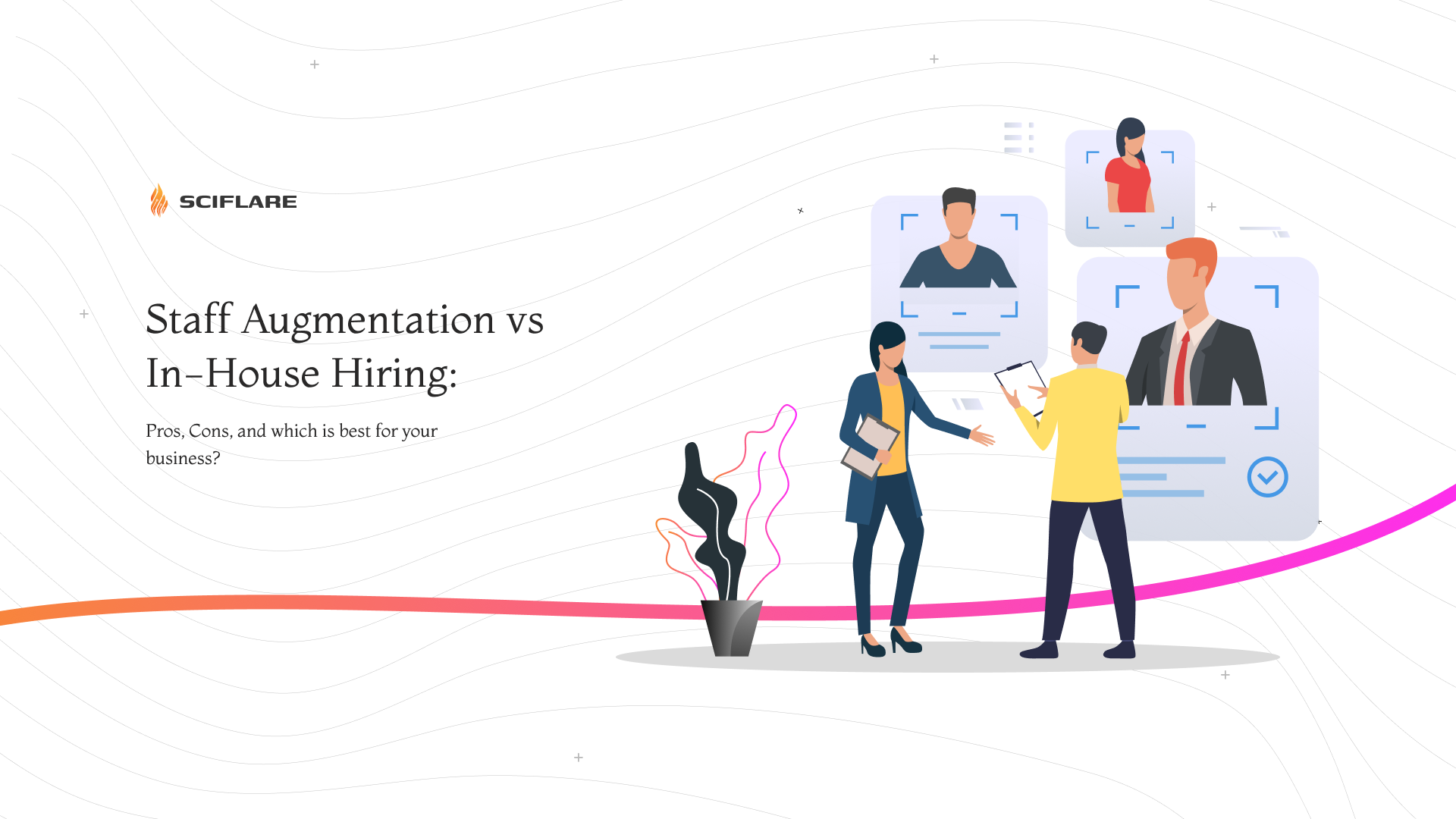
    Staff Augmentation vs In-House Hiring: Which Is Better For Your Business? 

    The search for cost-effective hiring models remains a top priority for all businesses today with the rapid pace of technological innovation and increasing costs of acquiring a customer. The rapid pace of technological innovation presents a challenge and an opportunity to create value combined, leading businesses to look for development talent tailored to their needs. In this context, staff augmentation and in-house hiring are among the two available options for businesses to close their skill gaps. But what does staff augmentation and in-house hiring mean, what does each hiring model entail, what are each one’s pros and cons and what is the best choice for your business?  

    Read our in-depth blog to find out to understand each hiring model better. Delve deep into our expert insights and make informed decisions for augmenting your team’s capabilities.  

    What is Staff Augmentation? 

    Staff augmentation refers to temporary staffing solutions that allow businesses to supplement their team’s internal skill gaps with outsourced resources. Businesses can avail development expertise tailored to their project needs based on flexible short-term contracts with the IT outsourcing company. Under this agreement, businesses get access to one (or more) development professionals as per their project needs, who report to them directly in this contract duration and get their projects up to speed.  

    IT staff augmentation services enable entrepreneurs to select the right development professional choosing from a vast and global talent pool and eliminate the limitations of traditional hiring, resulting in significant cost savings.  

    What is In-House Hiring?  

    The in-house hiring meaning is simple and straightforward. It means hiring your own development team in-house and giving them ongoing monthly salaries and the regular perks of any in-house team member. To build an in-house development team (frontend developers, backend developers, UI/UX designers, testers, and quality analysts), entrepreneurs need to invest time and resources in traditional hiring, search for the right talent, screen them over a lengthy hiring process, and onboard them expecting them to fit their culture.  

    Even though in-house hiring is fruitful for building institutional expertise, the main difference between staff augmentation and traditional hiring is that the former offers cost and time efficient solutions, while the latter requires hefty cost and time investments to produce the desired results and does not answer immediate needs to pace up with the competitive market.  

    Now that you have a basic idea of IT staff augmentation and in-house hiring, let us understand the pros and cons of each hiring model to understand when it is best to choose any hiring model.  

    Benefits Of IT Staff Augmentation 

    As of 2025, businesses are expected to spend approximately $81.87 billion on IT outsourcing. A report by Statista says that the IT outsourcing industry generated a total revenue of $460 billion in 2023. These statistics bear testimony to the increasing demand for IT resource augmentation, as businesses look for cost-effective ways to close their skill gaps and capitalize on available market opportunities ahead of their competitors.  

    IT resource augmentation has this high demand because of its efficacy and flexibility in meeting on-spot project requirements at critical business junctures. Sarah Chen, Tech Stars CTO, Forbes Technology Council (2024) said that- 

    “Staff augmentation allows startups to remain agile and access top talent without long-term commitments and overhead costs associated with traditional hiring.” 

    Discussed below are the major benefits of IT staff augmentation– 

    1. Flexibility  

    IT staff augmentation facilitates project-based hiring solutions, enabling businesses to adapt and quickly respond to evolving market needs. There is no need to enter a long-term commitment, hire a full-time resource, and pay them recurring monthly salaries with benefits (even when there is no project demand). Additionally, entrepreneurs can upsize or downsize their development resources as per their project needs and innovate with greater agility to meet evolving customer needs. 

    1. Access To Specialized Skills  

    Mobile app development has evolved exponentially with the latest advancements in technology and sheer diversity in user demand, making specialized technological skills indispensable for businesses dependent on core digital products. Temporary IT staffing gives businesses access to top-tier specialized skills from a global talent pool, ensuring tech versatility and flexibility in keeping up with modern demands, going beyond geographical limitations. 

    1. Cost Effectiveness 

    Hiring staff augmentation services gives businesses the major benefit of cost-effectiveness by eliminating in-office expenses, operating overheads, monthly salaries, and ongoing benefits, enabling them to supplement their internal skill gaps with top-tier talent at nearly half the price of building an in-house team. Businesses reported saving 20-30% of operational costs by eliminating traditional hiring processes, prolonged hiring cycles, and recurring salaries to be paid to an internal team. Additionally, outsourced IT professionals are trained on an ongoing basis by the company that employs them, thus saving training costs for businesses as well.  

    1. Instant Hiring Solutions 

    Outsourcing IT staff is considered the best hiring strategy today because of its ability to respond to instant business needs in a cost-effective manner. Whenever a project demand arises, businesses can tap into the pool of global talent and specialized skill sets offered by an outsourcing IT company and hire dedicated developers or a dedicated development team as per their needs signing a short-term contract. These professionals are ready to deploy and instantly kickstart development, not losing a minute in getting your project up to speed.  

    1. Extensive Exposure  

    When you compare staff augmentation vs in-house hiring, the former ranks higher with the extensive exposure across industries that outsourced IT professionals have. These professionals have worked on solving business problems with varying degrees of complexity and know industry-specific nuances first-hand as compared to the exposure of an in-house team, which takes years to build.  

    Cons of Staff Augmentation 

    When it comes to addressing business needs, there is no one-size-fits-all approach for anyone. Similarly, when it comes to choosing the best hiring strategy, it depends on the unique needs of each business in its respective growth stages. Additionally, outsourcing from an inefficient IT agency can convert the pros of staff augmentation into cons. Mentioned below are some cons of IT staff augmentation, particularly noticed with an inexperienced outsourced team: 

    1. Vision Misalignment  

    Staff augmentation and traditional hiring equally run the risk of vision misalignment and misaligned product teams. In the case of inexperienced IT teams, businesses can lose valuable time and resources if they are not aligned with their vision and miss out on development speed to get to market faster.  

    1.  Cultural Fit  

    IT staff augmentation entails working with an external team, making collaboration the cornerstone for a successful partnership. If the outsourced teams cannot culturally fit your internal team, development progress, speed and efficiency will be hampered.  

    1. Project Control 

    Outsourced development professionals work remotely. As such, it is important to maintain project control and gain timely updates to ensure there is complete alignment for all development efforts. With an inefficient outsourcing agency whose professionals are not adept in using remote project management tools, seamless collaboration may become a problem, affecting overall project outcomes.  

    Benefits of In-House Hiring 

    In-house development has ample benefits for businesses who have invested years in building institutional expertise, having spent time and money required for traditional hiring. Mentioned below are the benefits of traditional in-house hiring: 

    1. Institutional Expertise 

    Successful in-house hiring strengthens the fabric of the business over years of accumulating institutional expertise while working on multiple internal and client projects. These learnings are invaluable in boosting business resilience and niche expertise.  

    1. Seamless Collaboration 

    In-house team members can collaborate seamlessly and work towards a shared goal as a result of meeting every day and spending a lot of time together with fellow team members, leading to a cohesive and unified working environment that facilitates collaboration.  

    1. Long-term Growth  

    In-house hiring enables employees to look beyond the present situation and work towards long-term goals that shape the business organization in alignment with defined objectives. Their long-term commitment for the organization gives the partnership ample scope to work towards defined goals.  

    1. Project Control  

    In-house development eliminates the risk of losing project control as all development professionals work under the same roof and report internally, sharing timely project updates as required.  

    Cons Of In-House Hiring  

    Like any hiring model, in-house hiring has its own cons and is not suitable for all businesses. Mentioned below are some of its disadvantages: 

    1. Time Consuming  

    Traditional in-house hiring is time-consuming. Finding the right candidate for the vacancy often takes a lot of time because of broken hiring processes, advertisement loopholes, candidate availabilities, and more. All of these variables prolong the time from identifying a skill gap to onboarding the right professional for the same. Besides, in-house hiring cannot immediately answer an on-spot project requirement, and it takes years of investment for an in-house team to build the necessary expertise.  

    1. Expensive  

    Staff augmentation and in-house hiring vary greatly in terms of the monetary investment required for each. In-house hiring entails employing development professionals on a full-time basis, paying them regular monthly salaries and perks, and spending on their training and in-office requirements, making it unthinkable for most early stage businesses. Besides, the hiring process itself is resource intensive. Staff augmentation eliminates this recurring expense and training costs with a flexible one-time investment for a short-term basis.  

    1. Rigidity  

    Staff augmentation and traditional hiring also vary greatly in terms of agility. In-house hiring is rigid and makes it difficult to upsize or downsize development resources based on project needs. Staff augmentation is flexible by nature, empowering businesses to respond to dynamic market needs with enhanced agility and upsize or downsize development resources on a project-by-project basis. 

    Staff Augmentation vs In-House Hiring: A Comparison 

    CRITERIA STAFF AUGMENTATION IN-HOUSE HIRING 
    Cost-effectiveness Yes (no in-office, hiring, or monthly salaries) No 
    Agility Yes (scale development resources on a project basis) No 
    Competitive Edge  Yes (ready to deploy seasoned developers) Yes (with long-term investment) 
    Expertise Instant Access Expertise builds over time. 
    Geographical Limitation No, complete access to a global talent pool Yes, businesses are limited to their physical locations 
    Project Control Yes, with the right team Yes 

    When we compare staff augmentation and in-house recruitment, staff augmentation gets an upper edge because of its alignment with present day business requirements. Mentioned below are reasons why staff augmentation is considered the best hiring strategy today:  

    1. Staff augmentation is indispensable even with an in-house team  

    Startups and businesses in early growth stages can find it difficult to build their in-house teams. Hiring for individual, specialized roles and paying recurring monthly salaries, covering training expenses is bound to be more expensive and can lead to spending more before breaking even. Besides, even established businesses with competent in-house teams opt for staff augmentation when a project need arises, and the internal team is pre-occupied to cater to it.  

    In such a scenario, IT staff augmentation services ensure all businesses can access vetted and seasoned top-tier development talent without spending as much and without missing out on available market opportunities.  

    1. Time is Money! 

    Temporary IT staffing instantly meets the need of the hour, which traditional hiring cannot do. Traditional hiring entails lengthy hiring process and prolonged gaps between identifying a skill gap for a project and onboarding the right talent for the same. It is highly possible that an opportunity to innovate, serve customers better, and get ahead of competition may be lost by the time the right development professional (or team) joins your internal team.  

    In such a scenario, businesses can hire dedicated development team or dedicated developers and quickly respond to market demand. These professionals are ready to deploy, screened for talent and specific skills, and kickstart your project in no time.  

    1. Go Agile or Go Home! 

    Agility is not just another buzzword. It is a way of life for present-day businesses, enabling them to respond to their surroundings efficiently. This leaves no room for time and resource-consuming activities, something traditional hiring is characterized by.  

    Project-based hiring solutions are flexible by nature and enable businesses to upsize or downsize their development resources based on their current requirements. This eliminates the hiring roadblock and makes it a strategic tool for growth and scale.  

    Staff Augmentation Pricing Model 

    Developers Junior Developer (Cost Per Hour) Mid-Level Developer (Cost Per Hour) Senior Developer (Cost Per Hour) 
    Hire DevSecOps Engineers $20/hr $25/hr $30/hr 
    Hire DevOps Engineers $20/hr $25/hr $30/hr 
    Hire React Native Developers $15/hr $20/hr $25/hr 
    Hire Flutter Developers $15/hr $20/hr $25/hr 
    Hire Swift Developers $15/hr $20/hr $25/hr 
    Hire Java Developers $15/hr $20/hr $25/hr 
    Hire JavaScript Developers $15/hr $20/hr $25/hr 
    Hire Kotlin Developers $15/hr $20/hr $25/hr 
    Hire SwiftUI Developers $15/hr $20/hr $25/hr 
    Hire Spring Boot Developers $15/hr $20/hr $25/hr 
    Hire Vertx Developers $20/hr $25/hr $30/hr 
    Hire Android Developers $15/hr $20/hr $25/hr 
    Hire Test Automation Engineers $15/hr $20/hr $25/hr 
    Hire Manual QA Tester $15/hr $20/hr $25/hr 
    Hire NodeJS Developers $15/hr $20/hr $25/hr 
    Hire iOS App Developers $15/hr $20/hr $25/hr 
    Hire Mobile App Developers $15/hr $20/hr $25/hr 
    Hire Dedicated Developers $15/hr $20/hr $25/hr 
    Hire Backend Developers $15/hr $20/hr $25/hr 
    Hire Frontend Developers $15/hr $20/hr $25/hr 
    Hire AI Developers $20/hr $25/hr $30/hr 
    Hire Game Developers $20/hr $25/hr $30/hr 

    Explore The Best IT Staffing Services From Sciflare 

    Sciflare is a trusted destination for IT resource augmentation because of the following reasons: 

    1. Top-Tier Talent  

    Our development professionals rank among the Top 1% development talent in India and are seasoned experts in catering to diverse business problems of varying complexity. Our clients leverage their technical expertise and versatility to innovate and keep pace with evolving customer demands.  

    1. On-Time Delivery  

    We are solution partners rather than service providers and guarantee on-time delivery as part of our IT staffing services. Our experts follow a streamlined development process, understand your requirements, and work closely with your team to deliver on time, so you never miss out on an existing opportunity.  

    1. Cultural Fit 

    Our development professionals function as an extension of your team and seamlessly align with your cultural values to ensure fruitful collaboration. They have a proven track record of aligning with different business requirements and cultures to meet desired project outcomes.  

    1. Project Control 

    Our experts directly report to you for the duration of the contract and set up effective remote project management tools like Jira or Asana to make room for timely and seamless collaboration. Throughout our engagement, we share end-to-end project updates and seek your feedback to make sure all development efforts are aligned to the vision.  

    1. Quick Onboarding  

    Our IT staffing services follow a quick and flexible hiring process, where you can select the idea developer and onboard them within a span of 24-48 hours to kickstart development. No delay, no prolonged formalities, no missed opportunities! 

    1. Global Exposure 

    Businesses who choose to hire dedicated development team from Sciflare get instant access to our experts’ global exposure from over ten years of supplementing skill gaps with targeted expertise and quality output that meets and exceeds industry-specific expectations. 

    When To Choose IT Staff Augmentation?  

    IT resource augmentation is the need of the hour given the present-day business environment. It is wise to choose IT resource augmentation in multiple instances, such as, keeping up with competition, innovating in alignment with current requirements, catering to evolving customer needs with specialized advanced technology, exploring parallel market opportunities, and delving neck-deep into round-the-clock development. These are challenges which IT staff augmentation transforms into opportunities. This is when the proven expertise, agility, and development knowledge of a seasoned team proves invaluable, bringing in the perks of an internal development team without spending on one. Get in touch with us to hire dedicated developers and get that project up to speed! 

    FAQs 

    1. How does staff augmentation differ from in-house hiring? 

    Staff augmentation refers to onboarding a development expert on a project basis, who joins your team to complete the project assigned to them. Businesses enter a short-term contract with the company which employs and trains these professionals, and benefit from their ability to be ready to be deployed. In-house hiring refers to employing a full-time development professional and paying them regular monthly salaries and ongoing benefits, covering their training expenses.  

    1. In-house development vs staff augmentation: Which is better? 

    In-house development is better for established businesses have years of investment in their in-house teams, and require a specialized product. Staff augmentation is better for startups and early market entrants, as well as established businesses, ensuring each business has access to specialized expertise instantly in response to a project demand and can seamlessly navigate development complexities across all use cases.  

  • Fantasy Sports Industry Trends, Growth Drivers & Future Outlook

    Fantasy Sports Industry Trends, Growth Drivers & Future Outlook

    Introduction:

    As India’s Number one fantasy sports app development company, we know the firsthand importance of staying updated in the fantasy sports industry and acknowledging its dynamic evolution. What started as a means of participating in one’s favourite sport digitally has evolved into a mature ecosystem powered by technology, passionate sports communities across the world, and demand for more immersive and life like gaming experiences, moving significantly beyond traditional gaming.  

    As per a report by Statista, the fantasy sports user base in India will grow to 500 million users by 2027. So how can fantasy sports businesses enter this booming industry in 2025, how has the fantasy sports market growth over the years shaped user perceptions today, what are the latest industry trends and regulatory challengers before businesses, what strategies have worked well for established businesses, and what lies in the future ahead, find out in our in-depth article below.  

    Fantasy Sports Market Growth  

    An industry overview published by Dream 11 mentions that there were only 16 market players operating in India as of 2016. In a comparatively short duration of time, the number of fantasy sports businesses in India has gone up to 150, understating the rapid fantasy sports market expansion with soaring user demand. 

    A report by the Federation of Indian Fantasy Sports (FIFS) and Deloitte India mentions that the fantasy sports market will grow to INR 1,65,000 crores in 2025 from INR 34.61 crores in 2021, with a CAGR increase of 38% in just four years. Factors contributing to this exponential rise include: 

    1. Sports Obsession  

    Sports is the single most powerful phenomenon that can engage users across the globe. In the recent ICC Champions Trophy finals, JioHotstar registered 90.01 crore concurrent users when India lifted the winner’s trophy against New Zealand. It is a known factor that major tournaments like these fuel fantasy sports participation, as more and more fans assume roles of active team managers, ready to lead their virtual teams to victory. The FIFS reports that sports viewers have a high propensity to engage in fantasy sports because of its ability to augment their viewing experience.  

     Additionally, the proliferation of sporting leagues and tournaments throughout the year (including the IPL, pro-kabaddi, and football leagues) give fantasy sports users ample opportunities to participate in their favourite sports. As of 2022, there were 13 crore registered Indian fantasy sports users and 80 crore users viewing cricket content. Among this, the FIFS and Deloitte report that 85% of viewers are likely to convert as fantasy sports users.  

    1. Available Digital Infrastructure  

    Any fantasy sports market analysis is incomplete without understanding the widespread availability of the digital infrastructure that fuels its growth. The accessibility of the internet across every part of the country, along with widespread smartphone ownership, creates the perfect setting for fantasy sports app development, providing digital-native and sports-obsessed fans a medium to channel their strategic prowess as fantasy team managers. The FIFS and Deloitte India report mentions that the average age of the fantasy sports user worldwide is 37 years, while in India, it is the highest median between 25-40 years. Not only is this the world’s highest millennial population, but also a tech-savvy population with a high disposable income to spend on sports entertainment, a major pillar for fantasy sports engagement.  

    1. Sports Entertainment  

    The fantasy sports industry growth in India has been considerably faster than in other parts of the world. In India, the fantasy sports industry is hailed as the sunrise sector for the same reason, having witnessed exponential growth than mature and over 50-year- old fantasy sports ecosystems of countries like the USA. A considerable amount of this rapid growth can be attributed to the widespread sports entertainment in the country. The proliferation of leagues, accessibility of match viewing experiences on OTT platforms, passionate sports communities around celebrity players, and strategic partnerships for greater visibility on sports platforms make sports entertainment accessible to one and all. Fantasy sports apps enhance this accessibility further by giving users a platform that rewards them for their gaming opinions and how well they manage their selected virtual teams.  

    Fantasy Sports Industry Trends  

    As a fantasy sports app development company invested in delivering future-proof digital experiences to fantasy sports users, we have curated a list of industry trends from our first-hand experience of delivering the world’s leading fantasy apps like Boomer 11, American Dream 11, and more, keeping an eye on the industry trends from both,  user and client angles. Discussed below are popular trends that can inform your fantasy sports platform development in 2025: 

    1. Multiple Sports  

    Fantasy sports user engagement is becoming increasingly challenging amidst a plethora of options users have at their disposal and regulatory challenges that impact the viability of fantasy sports operations. In such a scenario, and with increasing demand for hyper-local sports such as Kho-Kho and Kabaddi, market leaders like Dream 11 are incorporating multiple sports along with cricket to provide an immersive gaming experience to users and benefit from the enhanced visibility and engagement during respective sporting leagues and live matches though the year.  

    1. Real-Time Data Integration  

    Real-time data integration is among the emerging trends in fantasy sports industry 2025. It enhances users’ decision-making by helping them optimize their lineups and team adjustments through real-time score updates, instantly reflecting how their selected players perform and giving them the necessary information to adjust their strategies. Accurate real-time score updates also reduce the cognitive load for the fantasy team manager making crucial decisions within a short timespan to beat fellow strategists at winning a virtual game.  

    1. Cross-Platform Compatibility  

    As a sports app development company, we have seen and catered to the growing demand for cross-platform app development. As businesses look for more and more cost-efficient ways to expand their reach among millions of fantasy sports users, cross-platform compatibility in fantasy sports apps presents itself as a top priority. Additionally, it is considered a must-have to ensure your fantasy sports app functions seamlessly across all devices with efficient data synchronization as users tend to log in at the same time using different devices and operating systems. As such, all fantasy sports must prioritize responsive design and adaptability to different screen sizes to maximize user engagement irrespective of the platform users are on.  

    1. Minimalistic Design  

    The best fantasy sports business solutions like ESPN, DraftKings, and Boomer 11, prioritize minimalistic design to ensure users can access and enjoy the core gameplay experience seamlessly. Selecting team players, optimizing lineups, and leading their virtual teams to victory constitute the core gameplay, which is heavily reliant on how users access and make sense of the available match data. Thus, minimalistic UX design facilitates these components, boosting engagement and retention over daily and season-long fantasy contests.  

    Our UI/UX experts have designed Boomer 11, UAE’s largest fantasy sports app with over 50,000 real users, with this exact precision in mind to give users an immersive experience and ability to focus on just what matters with non-cluttered screens, balanced colour combinations, and accurate font sizes.  

    1. Gamification  

    Gamification occupies the top spot for boosting fantasy sports user engagement in 2025. Dream 11, India’s first gaming unicorn, uses gamification strategies like team building, points, rewards, challenges, and daily streaks to maximize user engagement, keep users drawn to their platform for during the entire game, and incentivise them with targeted rewards that drive their internal motivation to participate in contests. Popular gaming apps like Winzo leverage gamified elements like referral rewards to make users come back for more and invite others with them, thereby extending the platform’s reach.  

    1. Social Integration  

    Sarah Chen, a leading gaming psychologist, said that “users don’t just want to play, they want to belong to a community. The most successful fantasy sports platforms understand this human need for connection and competition.” As fantasy sports app developers responsible for creating some of the world’s leading fantasy sports apps, we have witnessed this demand for social integration first hand. Integrating fantasy sports apps with social media or implementing features that incorporate social elements like sharing updates with friends, seeing how others are playing, or accessing player performances is a good way to make fantasy sports interaction more lifelike, satisfying the human need to belong to a community and staying within an immersive gaming ecosystem.  

    1. Multiple Payment Gateways 

    As India’s number one fantasy sports app development company, we have catered to clients worldwide and know how important seamless and secure transactions are for fantasy sports platform credibility. For our client American Dream 11, we integrated two different payment gateways for the USA and Canada users as both countries permit different payment platforms. As such, enabling users to transact in payment integrations permitted in their countries, and in their preferred medium is necessary for them to have a seamless fantasy gaming experience, constituting a major trend in 2025.  

    1. Multiple Game Formats and Languages  

    The fantasy sports market expansion has been fuelled by the proliferation of gaming leagues throughout the year for popular sports like cricket, football, hockey, kabaddi, and more. The FIFS and Deloitte India reported that approximately 87% of the fantasy sports revenue came from cricket as of 2022, including all formats such as T20, ODI, and more. As such, sports fans want to be engaged with these major cricketing (or other sports) events as much as possible, and offering multiple formats is a splendid way of making your platform accessible for all preferences. Additionally, as the sports culture permeates with enhanced digital penetration and viewing accessibility, more sports fans are seeking vernacular commentaries and multiple language support in fantasy sports apps, opening endless value creation opportunities with enhanced accessibility.  

    Top Fantasy Sports Technology Trends in 2025 

    We have helped fantasy sports businesses across the globe with custom fantasy sports app development by delivering solutions tailored to their unique preferences for technological advances, user engagement, and revenue maximization. As solution partners, we enable our clients to remain at the forefront of technological innovation, and from this first-hand experience, we have listed some major fantasy sports technology trends in 2025:  

    1. Fantasy Sports Automation With AI  

    AI fantasy sports app development is on the rise with AI’s capability to personalize fantasy gaming experiences for each user, enhance strategic decision-making for fantasy team managers with predictive analytics, structure raw data, convert it into actionable insights for winning a game, and learn from users’ preferences and gaming habits to tailor strategies for them.  

    The Yahoo Fantasy app uses AI to facilitate data-driven decision-making for users by providing tailored recommendations for upcoming matches, reducing their reliance on chance and improving their strategies by eliminating guess work.  

    1. Blockchain In Fantasy Sports  

    Fair gameplay and secure transactions are non-negotiable constituents of trust for ensuring a credible and transparent gaming environment. Blockchain technology in fantasy sports helps businesses achieve just that by ensuring tamper-proof and authorized transactions and withdrawals, offering DeFi features to facilitate smart contracts and automated distribution of prizes, and integrating non-fungible tokens to offer users unique digital assets. For example, Sorare, a fantasy soccer platform, offers its users non-fungible token player cards to compete in tournaments.  

    1. AR/VR Integration With Fantasy Sports  

    Technologies like augmented reality (AR) and virtual reality (VR) redefine how users participate in sports and engage with gaming experiences. AR/VR implementation in fantasy sports apps enables users to experience lifelike excitement for the game with real-time information, 3D replays, interactive training sessions, and more. Popular fantasy sports apps like DraftKings use the combined potential of AR and AI to provide users with accurate performance data and insights for optimizing their strategic line ups.  

    1. Cybersecurity  

    As a sports app development company, we have seen the rising need for enhanced data security measures to protect users’ transaction data and maintain the credibility of the fantasy sports platform. For this, fantasy sports businesses must prioritize security from the outset, incorporate multi-factor authentication, and implement measures to detect fraudulent activities, bot or duplicate accounts, and phishing attempts that can impede a fair and transparent gaming environment.  

    Fantasy Sports Revenue Models 

    If you are wondering about how to start a fantasy sports company, one of the major things to consider is how to make money from your fantasy sports app. In addition to monetization strategies, it will require the right balance of tech and business understanding, tried and tested user engagement strategies, and adherence to regulatory establishments till date. Mentioned below are some fantasy sports monetization strategies used by popular market players:  

    1. Entry Fees 

    All fantasy sports platforms charge users an entry fee or fee to participate in a particular contest. The key to earning substantial revenue from entry fees is to expand your user base and offer users multiple opportunities to participate in fantasy sports, keeping in mind the viability of the entry fees for the user and your business.  

    1. In-App Advertising  

    A successful fantasy sports app will have a passionate community of users with similar interests. For example, a successful fantasy cricket app will have cricket lovers who take interest in fitness, game strategies, merchandise, and more. In such a scenario, partnering with third-party advertisers for advertisements on products your users will find useful is a viable revenue source. Additionally, with advanced machine learning algorithms, you can tailor advertisements to users to improve conversion rates and earn significant commission from every purchase made on your platform.  

    1. Premium Features  

    Custom fantasy sports app development gives fantasy sports businesses an opportunity to include a careful selection of premium features in their offering to attract gaming fans who want more than just standard options. With fantasy sports users desiring more control in their hands as fantasy team managers, features like real-time data updates, predictive analytics, and personalised recommendations emerge as tools that enhance their decision-making, improve their competitive edge, and willingly want them to make in-app purchases.  

    1. Affiliate Marketing  

    Fantasy sports apps can make money by promoting other products and services that align with the interests of their users. Promoting their brands on your platform leveraging its gathering of sports fans can be a major driver of revenue as more and more users join your platform with the same interests.  

    Is Fantasy Sports Legal In India?  

    Yes, fantasy sports are legal in India because they have been classified as games of skill as opposed to games of chance (like betting or gambling). Their classification as games of skill highlights the role of users in leading their virtual teams to victory, exercising their strategic decision-making capabilities, interpreting available match data to their strengths, and responding to evolving match circumstances faster than their opponents. The role of the fantasy sports user combines passion for sports, data analysis, strategic decision-making, and social networking into one.  

    In an order passed by the Supreme Court of India on 30 July 2021, fantasy games were recognized as games of skill, dismissing all reliance on chance and guess-work, and setting them apart from betting, gambling, wagering. Among other fantasy sports regulatory challenges come the implication of the Goods and Services Tax (GST)- a 28% GST levied on the face value of every bet placed on fantasy sports platforms.  

    Other fantasy sports legal challenges across the world include the prohibition of the use of real money for fantasy sports transactions in all Gulf countries. Additionally, each country and platform have their specific licensing requirements for fantasy sports platforms, without adhering to which businesses cannot seamlessly function as entities providing fantasy sports services.  

    How To Overcome Challenges In Fantasy Sports Business? 

    Along with regulatory challenges, fantasy sports businesses face other challenges in terms of profitability, viability, competitiveness, and more. Discussed below are some challenges and ways to overcome them to start a profitable fantasy sports business in 2025: 

    1. Responsible Gaming  

    Digital games come with the responsibility of preventing addiction in users. With season-long fantasy games, and back-to-back sporting leagues throughout the year, users can find fantasy games addictive and difficult to live without. In such a scenario, we have devised a feature for responsible gaming that enables users to set time limits for participating in paid contests, empowering them with a choice for when they want to engage with fantasy sports.  

    1. Lag-Free Performances In Peak Load periods  

    Upcoming tournaments like the IPL witness concurrent viewership and engagement. The recent ICC CT where India beat New Zealand to clinch the trophy saw 90.01 crore concurrent viewers on Jio Hotstar. It is known that such events maximize engagement on fantasy sports platforms, when millions of users access the app from different devices and operating systems at the same time.  

    To ensure lag-free performances in peak load periods, we implement auto-scaling for the server to automatically adjust to the user spike, and efficient load balancing techniques to ensure spikes in user engagement are evenly distributed. Additionally, our solutions are designed with core scalability in mind leveraging cloud infrastructure to optimise for peak match-time surges.  

    1. Competition  

    The best fantasy sports business solutions like Dream 11, American Dream 11, Boomer 11, and more stand out to their loyal user base for a top-notch experience others find hard to replicate. Be it intuitive design, top-notch performance, seamless payments, or adherence to gaming laws, each of these market favourites stand out from the competition by continuously improving their user experience. The FIFS points out that users today have several fantasy sports apps at their disposal, and being a technology-driven sector, leveraging technological advancements to improve the core gaming experience is what will set one market player apart from the other to build a loyal user base.  

    1. Dynamic Evolution 

    Fantasy sports users today are more than just passionate sports fans. With their evolving role as strategists, data analysts, and networkers, their demand for enhanced decision-making tools is on the rise. Users don’t just want features that bring them the fantasy gaming experience, they desire a gaming companion that can be their right hand at the game and help them leave fellow players behind. Additionally, with rapid advancements in technology and digital experiences, businesses need to continuously evolve to keep up with the industry’s dynamism, creating innovative opportunities from these challenges.  

    1. Profitability  

    With fantasy sports regulatory challenges, businesses must leverage the right tech stack, development expertise, user engagement, and go-to-market strategies to remain profitable and keep their operations viable, minimizing the impact of regulations on their established user base. This needs a careful balance for technological investment with the right solution partner, understanding of your user base dynamics, their income streams, and alignment with the overall business requirement to achieve profitability and grow sustainably in the long run.  

    For this, businesses must consider providing a complete and immersive gaming experience, going beyond a single sport, and make their platforms accessible to a wider user base to scale.  

    The Future of Fantasy Sports  

    The fantasy sports industry has a bright future ahead with the necessary digital infrastructure, investments, and established user demand in place. However, the metrics which businesses have chased for so long to evaluate their fantasy sports success will evolve to newer metrics more qualitative in nature, where the complete fantasy gaming experience, users’ participation and engagement with all features, willingness to bring more users to the platform will be evaluated to understand how well a fantasy sports solution fits their lives and digital experiences. We have helped global leaders achieve both qualitative and quantitative metrics (like revenue, number of users) over the past ten years, and are ready to help you establish a credible presence in the competitive fantasy sports ecosystem. Get in touch today and build the fantasy sports app of your dreams with Sciflare! 

    FAQs 

    1. What is the cost of developing a fantasy sports app in 2025? 

    The cost of developing an off-the-shelf white-label solution that businesses can rebrand as their own starts at approximately $5k per sport. The cost of custom fantasy sports app development ranges between $15k-$100k depending on unique business needs. 

    1. How long does it take to develop a white-label fantasy sports solution?  

    With Sciflare as your solution partner, your white-label solution will be ready for launch within 14 days, provided you have your OTP service and payment gateway applications filed.  

    1. How long does it take to develop a custom fantasy sports app?  

    Custom fantasy sports app development can take approximately 3-6 months, ensuring end-to-end custom development from scratch, implementation of features unique to your business, tech stack of your choice, and complete source code delivery.  
  • Building An App Like Dream 11- Everything You Need To Know 

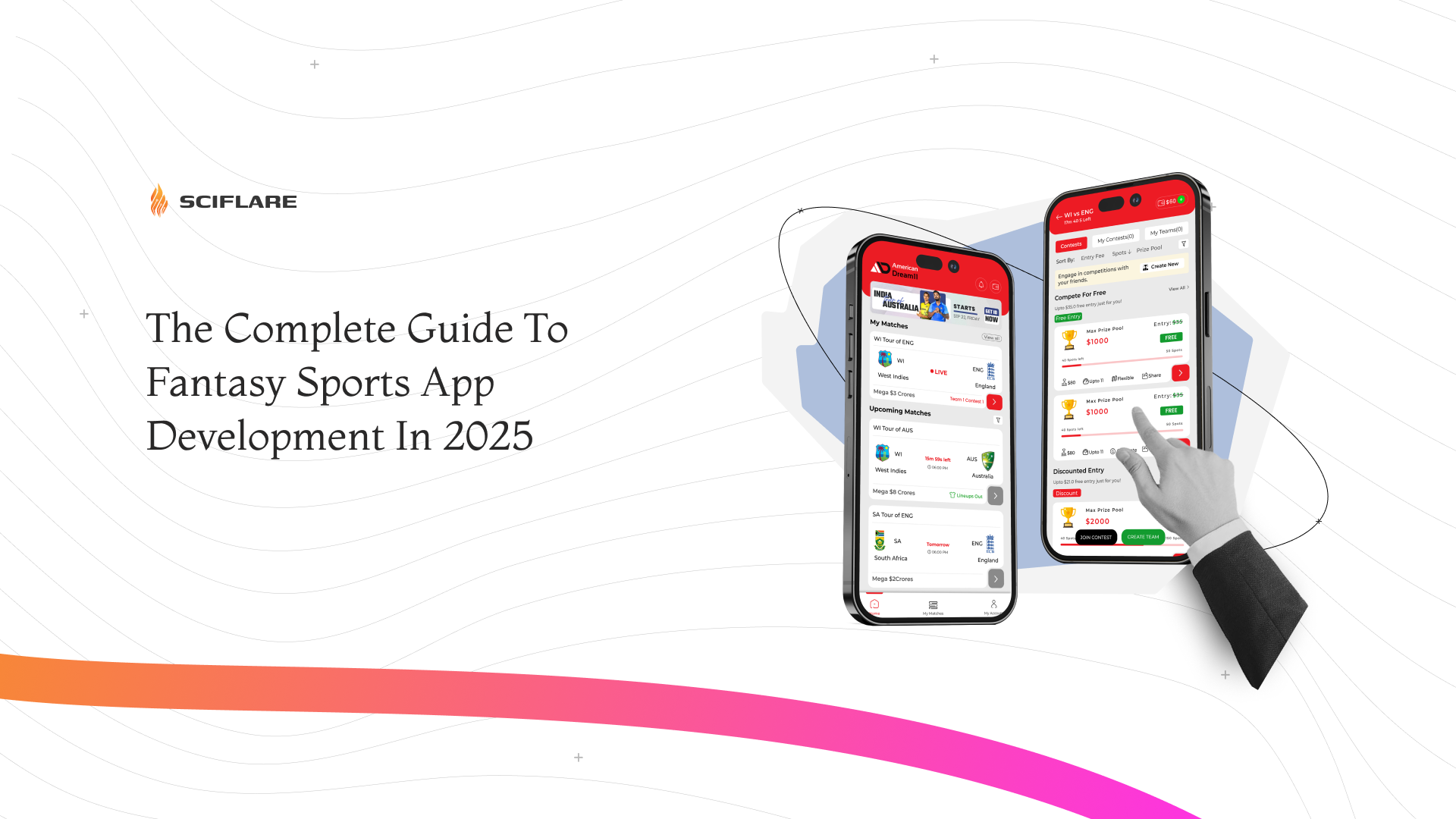
    Building An App Like Dream 11- Everything You Need To Know 

    Quick Summary: 

    • Fantasy sports app development is booming, with Dream 11 leading the space. Developers must focus on user engagement, real-time updates, and intuitive interfaces. 
    • A top-tier fantasy sports app must offer seamless team selection, real-time player stats, AI-driven insights, and a structured information hierarchy for easy navigation. 
    • Handling peak traffic requires auto-scaling servers, optimized load balancing, and real-time data synchronization to ensure a smooth gaming experience. 
    • Successful apps generate revenue through entry fees, commission on winnings, in-app ads, and premium features, making business viability a priority from the start. 
    • Developing a fantasy sports app like Dream 11 involves UI/UX design, backend infrastructure, testing, and regulatory compliance, with costs ranging from $15K to $100K. 
       

    Introduction 

    India’s love for cricket needs no introduction. In 2020, the highest search term on Google across the world was “Covid 19”, but in India, at that same time, it was cricket. Fantasy cricket app development rightly provided the passive and passionate spectators of our sports-obsessed nation a platform to channel their opinions on cricket strategies, create their own virtual teams, and win rewards for the same. Dream 11 has witnessed exponential growth in this space, with 220 million+ users as of March 2024, and till date there are approximately 100-1k monthly searches on Google for apps like Dream 11. 

    As India’s number one fantasy cricket app development company, we have seen and catered to this exponential demand firsthand. Dream 11 has become synonymous with the activity of playing fantasy sports in India and has become the parameter against which any fantasy cricket app is evaluated. Not only is it India’s first fantasy gaming unicorn but also a widely loved fantasy cricket platform with 15.01 million concurrent users as of March 2024. What makes it so popular? Let’s decode its success and understand the essential components that go into the making of the best fantasy cricket app just in time for IPL 2025. 

    Decoding Dream 11 App Development 

    The success of fantasy sports app development depends on how well any platform can engage and retain users, and continue to give them a seamless gaming experience that matches their excitement for the real game. Discussed below are essential components of a fantasy cricket platform with the potential to captivate users like Dream 11: 

    User Interaction With The App  

    The best fantasy cricket app will facilitate seamless user interaction with each of its components and fulfill users’ purpose of engaging with it. Fantasy cricket lovers want to be able to create their virtual teams, select their players, optimize lineups, and lead their teams to victory seamlessly with all necessary data at their disposal.  

    An important aspect of users’ interaction with any fantasy gaming app is the amount of cognitive load it gives them while they apply their strategic decision-making capabilities to win the game. Given the short time they have to make critical decisions processing all data, there is no room for cluttering the home screen or points table with anything unnecessary than information they require at any given moment. Users should be simply led after the onboarding to the home screen, which shows all upcoming matches and contests users can participate in, from where they can easily proceed, following a well-structured information hierarchy.  

    Dream 11 enables users to easily select their teams with critical data such as, player performance, match conditions, clear rules for points calculation, well-defined rules for each match format and so on.  

    Data Calculation and Representation 

    Fantasy sports are games of skill as opposed to games of chance. Users’ victory in a game depends on how well they can leverage their strategic decision-making capabilities and available match data to get ahead of their fellow players. As such, the platform should facilitate this capability and not get users to worry about the accuracy of points being calculated and updated in real-time.  

    Dream 11 users can use the available match data to their strengths as the platform converts raw data into actionable insights users find most handy when selecting their teams, or predicting how weather conditions, injuries, or current match conditions favour their picked players for timely lineup optimization. Fantasy cricket app development with data calculation accuracy, clean presentation, right font sizes, and optimal colour choices in alignment with the app’s interface reduces users’ dependence on guesswork and empowers them as fantasy team managers leading their teams for victory.  

    This accuracy is pivotal to the business success of any fantasy sports app. It is the parameter against which the fantasy gaming experience is judged and with fantasy sports API solutions, it has become easier than ever to integrate diverse match data from credible sources into your fantasy cricket application. 

    UI/UX Design 

    Dream 11 app development is incomplete without a consideration of the stunning UI/UX design strategies followed by fantasy sports apps with massive user engagement. It is not just about having the most visually appealing or striking array of features put together, but really understanding how well the app can capture the essence of a real-life game and fuel users’ excitement as passionate fans transformed to active team managers.   

    An app like Dream 11 prioritizes visual consistency for users and enables them to achieve their goals (primarily joining contests and selecting a team) seamlessly in as much time as possible. Their focus is on enhancing this core gameplay, recognizing it as the major source of their revenue. Additionally, they incorporate design thinking from the outset and follow an agile double-diamond design process to make sure user needs are accurately translated to their functional product. 

    As a fantasy cricket app development company responsible for delivering some of the world’s leading applications like Boomer 11 with over 50,000 real users, we prioritize visual consistency in design, ensuring an accurate balance of colours and typography, and leverage stunning graphic elements to provide users a thrilling, yet seamless gameplay experience that makes them come back for more. 

    App Performance 

    Application performance is pivotal to the success of fantasy cricket software development. To create app like Dream 11, it is important to ensure that the application can provide consistency in the launch time, when millions of users join contests from different devices. Besides, the application should be able to offer a lag-free performance during peak match users, when millions of users engage with the app concurrently.  

    Cricket app development like Dream 11 provides for specific configurations of each device and operating system to minimize the launch time and provide users a seamless experience in the crucial final 30 minutes remaining for the match to begin. Dream 11 also avoids the possibility of slow app performance when millions of users engage with the platform concurrently with different devices and in different network conditions through auto-scaling and efficient load-balancing, ensuring the server can automatically scale up when user engagement spikes.  

    This guarantees consistent performance and top-notch user experiences, matching up to the excitement of sports fans all set to select their teams, apply their strategic capabilities, and lead their teams to victory.  

    Tech Stack 

    As India’s number one fantasy cricket app development company, we understand the importance of choosing the right tech stack for your fantasy cricket platform and have helped several leaders in the space identify the right tech stack for their respective purposes to avoid non-reversible damages. To build an app like Dream 11, identifying the right tech stack is important to ensure desired functionality, scalability to evolve with increasing user engagement, and top-notch performance to cater to different devices and platforms simultaneously. Mentioned below are the basics for a fantasy cricket tech stack  

    Category Technologies 
    Frontend Android: Kotlin 
    iOS: Swift, SwiftUI 
    Both (Android & iOS): React Native, Flutter 
    Backend Node.js, Java, PHP 
    Database MongoDB, SQL, MySQL 
    Cloud Integration AWS, Azure 
    Payment Gateway Integration PayPal, Cashfree, PhonePe, Gigadat, Razorpay, CCAvenue 
    Push Notifications Firebase 
    Web Technologies HTML, CSS, Astro, React, Next.js 

    (which will vary according to unique business requirements)- 

    How The Sports Entertainment Industry Fuels Visibility For A Fantasy Cricket Platform 

    Fantasy cricket apps witness an upsurge in engagement during leagues like the IPL. The major factor fuelling enhanced visibility is the increasing popularity of sports and the growth of the sports entertainment industry, which seamlessly distributes these events among the masses.  

    The proliferation of leagues like the IPL, pro-kabaddi, hockey, and football, along with enhanced broadcast quality, increasing celebrity endorsements, enhanced internet penetration, smartphone ownership, and ease of OTT viewing has made these popular sporting events more accessible to everyone, enabling users with greater opportunities to engage with fantasy sports all throughout the year.  

    Apps like Dream 11 focus on multiple sports to offer users an immersive fantasy gaming experience, leveraging the enhanced visibility offered by the sports entertainment industry and multiply their revenue sources as more passionate sports communities form around these events, fuelled by a growth in social media. Additionally, strategic partnerships during major leagues enhance visibility and fuel user engagement with the right incentives for users. 

    Features To Include In An App Like Dream 11 

    Discussed below are features to include in your app for Dream 11-like engagement and retention.  

    COMMON FEATURES ADVANCED FEATURES ADMIN PANEL FEATURES 
    Mobile and Social Login Instant Withdrawal User Authentication 
    Referral System Wall Feed Instant ID Verification 
    Automated KYC User vs User Comparison Bank Verification 
    Real-time Fantasy Games Quizzes Withdrawal Requests 
    Multiple Fantasy Game Contests Multiple Sports User Created Games 
    Payment Gateway Integration Predictions Swapping Teams 
    Player Analytics E-Commerce Default Fantasy Games 
    Live Scores Engaging Push Notifications Substitution System 
    In-app Chat Features Gamification Admin Dashboard 
    Join Multiple Fantasy Games Rewards & Bonuses Creating Multiple Teams 

    Other features in popular demand include: 

    Multiple Sports  

    If you are looking to build a app like Dream 11, consider incorporating multiple sports in your platform along with cricket, like kabaddi, hockey, football, kho-kho, and more. Not only will this give users an immersive gaming experience with a plethora of gaming options in one place, it will also provide opportunities for multiplying revenue given the proliferation of sports leagues for each of these games all throughout the year, giving users enough opportunities to participate in fantasy sports and win prizes.  

    Predictor Module 

    Top Dream 11 alternatives like Boomer 11 come with a predictor module that helps users predict the outcomes of a contest they enter to enhance their strategic decision-making capabilities. As fantasy sports become more popular among a rapidly evolving and mature user base, the presence of these modules will be the true differentiator for any fantasy sports business that wants to stand out from the plethora of other market alternatives.  

    Bitcoin-based Payment Integration 

    Fantasy cricket software development should evolve with the times to keep up with user demand and offer them payment integrations as per their needs. Bitcoin-based payments are the next future-proof feature every fantasy sports business will look to incorporate as these technologies revolutionize transactions across industries. 

    How To Make Money From A Fantasy Sports App Like Dream 11

    Discussed below are ways in which Dream 11 makes money and other monetization strategies you can explore to increase your revenue from fantasy cricket app development.  

    The primary sources of Dream 11’s revenue are: 

    Entry Fees 

    Dream 11 earns revenue from the entry fees each user pays to participate in paid contests on their platform. Popular tournaments like the IPL, the ICC World Cup, T20 and ODI formats see an upsurge in user registrations on fantasy sports platforms and as of 2023, Dream 11 reported an average spend of approximately INR 127 per user. The key to earning substantial revenue from entry fees is prioritizing viability for the user and business, and implementing an amount that also minimizes the impact of regulations like the 28% GST in India.  

    Commission On User Wins 

    Dream 11 earns revenue by charging a commission on users’ prize pools or amounts each user wins based on how well their virtual teams perform. As of the end of 2023, the platform reportedly earned a 15%-20% commission on user earnings, leveraging its targeted engagement strategies and incentives for users to drive greater participation.  

    Enhanced Platform Accessibility  

    For anyone looking to build a Dream 11 clone app, it is important to consider how Dream 11 has strategies in place to extend their platform accessibility to a wider user base by offering three gaming options, including freemium, private, and premium to meet users’ diverse preferences to spend on fantasy sports platforms.  

    Other monetization strategies for fantasy sports apps include- 

    In-App Advertising 

    AI-powered user insights can learn from users’ engagement habits and offer tailored strategies for more effective and relevant in-app advertising for each user, maximizing the chances of conversion and generating greater revenue for the platform.  

    Affiliate Marketing 

    fantasy cricket app has the potential to attract billions of cricket lovers on its platform with the right user engagement strategies. With billions of cricket lovers constantly participating in daily and season-long games, there are endless opportunities for partnering with sports retailers to sell game merchandise and equipment on your platform in exchange for a commission for each purchase.  

    Premium Features 

    A report by Deloitte India and the Federation of Indian Fantasy Sports (FIFS) mentions that fantasy sports is a technology-driven sector and technology is the core differentiation strategy with users having a plethora of gaming options at their disposal. The nature of user demand today leaves ample scope for designing premium features which users will willingly pay for in exchange for enhanced strategic decision-making capabilities that improve their chances of winning.  

    How To Build An App Like Dream 11 In 7 Steps 

    Discussed below is the end-to-end development process for building a Dream 11 clone app or a fantasy cricket platform tailored to the needs of your business.  

    Step 1: Initial Conceptualization 

    In order to develop the best fantasy cricket app, we conduct in-depth market and competitor research to understand your target users, identify gaps in current offerings, and create a development roadmap in alignment with your vision. 

    Step 2: UI/UX Design and Backend Development  

    Our fantasy sports app portfolio constitutes the best Dream 11 alternatives with proven UI/UX design strategies in place to maximize user engagement and retention and eliminate hassles from a smooth user experience. We understand your design, component, and colour preferences, along with any model apps you may prefer, to deliver UX designs that translate your user and business needs into fully functional products. Backend development begins parallely to build a robust system foundation that supports you at growth and scale.  

    Step 3: Development  

    Our custom cricket app development delivers apps in alignment with clients’ specific technical preferences, including databases of their choice, custom coupon and module implementation, and complete source code delivery, ensuring complete relevance, alignment with business needs, and end-to-end accuracy.  

    Step 4: Admin Panel and Application Development 

    As part of our fantasy cricket platform, we develop an Admin Panel that empowers clients to effectively manage their fantasy sports business with consolidated data in a secure repository, including data points like KYC, user activity tracking, state restriction options, referral calculation, and more. Application development at this stage progresses in alignment with client preferences indicated above.  

    Step 5: Sprint Demos 

    As part of our fantasy cricket software development process, we present the demo of each model and fantasy sports API every two weeks. This is when we deliver the complete source code to you, and also manage application hosting for clients who want to host the application on their servers.  

    Step 6: Testing and Quality Analysis 

    To create an app like Dream 11, it is important to ensure that your platform can handle concurrent user demand and function efficiently in all possible match scenarios for seamless user engagement. We conduct end-to-end testing for complete coding accuracy along with scenario testing leveraging our extensive and prior knowledge of test cases to identify and nullify potential issues for a flawless launch.  

    Step 7: App Store and Play Store Release  

    We help you launch your fantasy cricket platform on App Store and Play Store, providing for all required formalities for each platform and ensuring your solution can reach your target environment seamlessly.  

    Dream 11 Alternative Apps and Their Features 

    Discussed below are some of the Dream 11 alternatives along with their features to help you get an idea of what users expect today and what is most popular among them. 

    Fantasy Sports Apps Developed by Sciflare 

    App Name Key Features 
    Boomer 11 Daily Fantasy, Predictor, Quiz, Social Feed, E-commerce Integration, Virtual Coins, Live Scorecard 
    Fanze Prediction, Live Chat, Scorecard, Coupon Purchase System 
    Fantasy Sports Pro Daily Fantasy, Predictor 
    Superleague Daily Fantasy, Local Leagues, Local Scorecard Updates 
    AD11 DFS (Daily Fantasy Sports), KYC Verification, Multiple Payment Gateways for Different Countries 
    DPL11 DFS, Cashback and Referral-based Networking System 

    How Much Does It Cost To Develop A Dream 11 Like Fantasy App

    The fantasy cricket app development cost in India varies from business to business depending on their unique requirements and tech stack. However, two major development options remain- 

    1. White-label fantasy app development: Starting at $5k-$15k per sport and ready to go to market in 14 days. 
    1. Custom Fantasy App Development: Costs range from $15k-$100k depending on the kind of functionality and experience businesses want to offer their users, and ready to go to market in 3-6 months.  

    Conclusion 

    Building an app like Dream 11 entails understanding what makes it so loved. Despite regulatory challenges, Dream 11 has witnessed unprecedented user growth and continues to remain a top-choice among users with its continuous improvements to the platform, focus on enhancing the core gameplay experience with AI and ML integrations, and ability to offer reliable performances to the millions of sports fans who join the platform every minute. It also includes prioritizing data security from the outset and alignment with all established regulations to maintain credibility and provide a safe gaming experience. We have worked with several industry leaders, including Boomer 11, America Dream 11, DPL 11, and more to help them launch their fantasy sports solutions exactly the way they needed, and are ready to leverage our expertise cultivated over ten years to help your dream fantasy cricket solution too. Get in touch today! 

    FAQs 

    1. How long does it take to make app like Dream 11

    It can take approximately 3-6 months to develop a custom app like Dream 11 tailored to your unique business needs. However, for clients who need quick launch solutions, our white-label fantasy sports software is ready to go to market in 14 days with customizable brand identities.  

    1. What is the Dream 11 app cost

    The cost of developing a custom application like Dream 11 can range anywhere between $15k-$100k depending on your feature, customization, tech stack, and other unique business requirements.  

  • Fantasy Sports App Development Guide 2025 | Features & Cost

    Fantasy Sports App Development Guide 2025 | Features & Cost

    Introduction:

    Sports is the single most effective medium that brings people together across the globe. Be it cricket, hockey, football, baseball, basketball, kabaddi or more, each of the sports with its respective tournaments and leagues leads to a proliferation of viewership and engagement from passionate and opinionated spectators in respective parts of the world. This has made fantasy sports the single most effective platform to transform the passive spectators to active team managers who can leverage their strategic opinions to lead their virtual teams to victory and win rewards for the same.
    The demand for fantasy sports app development is on the rise in 2025 with the market valuation expected to reach $34.23 billion , growing at a CAGR of 11% as per a report by the Business Research Company. Being a technology-driven sector with a plethora of options available to users, the success of fantasy sports app solutions depends on how well they can engage their target users and simplify their journey to create virtual teams and win.

    So, what are the key considerations while developing a fantasy sports app, what features are popular among users, how to cater to compliance measures across the globe, and how to monetize your fantasy sports app while maximizing engagement and retention? Read this in-depth guide that we have curated from our experience as India’s No 1 fantasy sports app development company to find out.

    The Time is Ripe for Fantasy Sports Software Development


    First and foremost, it is important to learn about the benefits of investing in fantasy sports software development to identify areas of value creation with your fantasy sports app and understand the ecosystem that has fuelled the meteoric rise of this industry.

    Lucrative Market


    The Fantasy Sports Gaming Association in 2022 mentioned that in the USA and Canada alone, there were 63 million active users on fantasy sports platforms with the numbers increasing every day. According to the Zion Market Research Report, the global fantasy sports market is estimated to reach USD 102.37 billion by 2032. In India alone, there were 13 crore registered fantasy sports users as of 2022. With the increasing number of users flocking to fantasy sports platforms, proliferation of gaming leagues throughout the year, stable and accessible internet infrastructure, and digital-first lifestyles of users, there is ample opportunity to create value with fantasy sports app development by creating platforms tailored to the needs of each user base, including their gaming expertise, language preferences, gaming preferences, and more.

    Revenue Generation


    As fantasy sports app developers responsible for creating some of the leading fantasy sports apps such as Boomer 11, American Dream 11, DPL 11, and more, while catering to diverse fantasy sports use cases across industries, we have seen the stable revenue stream generated by well-targeted fantasy sports apps first hand. Be it businesses’ core revenue stream or an exploration of an additional one to capitalize on the global popularity of sports, the proven testimony of fantasy sports ROI maximization, our clients have seen significant returns with solutions aligning cutting-edge technology with their business needs to offer users top-notch fantasy gaming experiences.

    Classification and Accessibility Of Fantasy Sports


    Fantasy sports are categorized as games of skill by major sports nations across the world as opposed to games of chance. The accessibility of fantasy sports solutions is further fuelled by enhanced digital penetration, smartphone ownership, affordable mobile data (particularly in India as compared to other parts of the world), and mature technology infrastructure to cater to evolving user needs. These prerequisites for antasy sports app development, including established user demand, familiarity with the model, and willingness to spend on these platforms are readily available and strongly established.

    Flexible Investment and Development Ease


    With the growing popularity of fantasy sports among users, entrepreneurs have the option of investing in custom fantasy sports app development or white-label fantasy sports solutions development depending on their needs. The former enables businesses to develop a solution completely tailor-made for them from scratch, while the latter enables quick market entry and risk-free testing of initial waters with a 14-day launch period and minimal investment. Additionally, with fantasy sports AP, businesses can get readily available game data from diverse and credible sources without having to aggregate it from scratch, further simplifying and accelerating development.

    The Fantasy Sports App Development Process: How To Develop A Fantasy Sports App in 2025?


    Mentioned below is the end-to-end process for custom fantasy sports app development.


    Step 1: Initial Conceptualization


    As a fantasy sports development company prioritizing alignment of technology to meet client’s business goals, we undertake in-depth market research and competitor analysis to understand your target market, identify competitor gaps, and define your unique selling proposition, following which a feature list and development roadmap is created in alignment with your vision.


    Step 2: UI/UX Design and Backend Development


    Our fantasy sports app development services cater to the unique design requirements of each business from scratch. At this stage, we understand your specific design, style, component, and colour preferences to deliver top-notch designs that instantly connect with your users. Additionally, if you have a preferred app design or want to implement specific ideas from widely popular fantasy sports apps like Dream 11, our UI/UX experts cater to these requirements to deliver an app in alignment with your vision, designed to meet the goals of your target users. At this stage, backend development from scratch begins parallelly, ensuring robust system foundation for flawless functionality.


    Step 3: Development


    Our custom fantasy sports app development caters to clients’ specific technical preferences and deliver fantasy sports solutions in programming languages and databases of their choice, with complete custom source code delivery to each business. Our fantasy sports app developers are tech and platform versatile, adept in all latest technologies, ensuring seamless development and deployment across all platforms. Once we receive the confirmation on the technical aspect from our clients, we proceed to add specific models and functionality as per your choice, including custom coupon implementation, e-commerce implementation, or development of a predictor module to empower your users with enhanced decision-making capabilities.


    Step 4: Admin Panel and Application Development


    At this stage, our experts develop the Admin Panel to empower clients to seamlessly manage their fantasy sports platforms, ensuring they have complete access to all necessary datapoints in one place, including user registration details, end-to-end user activity tracking, state restriction, KYC details, referral and transaction details among others. In alignment with client preferences indicated in the stages above, application development happens parallelly at this stage.


    Step 5: Sprint Demos


    As part of our fantasy sports software development, we present the demo of each model, including the fantasy sports API every two weeks. At this stage, the complete source code is also transferred to the clients and in case they want to host the application in their server, our experts manage that seamlessly too. Transparency at every stage is important to us and we ensure proactive communication to keep out clients updated regarding progress made and continuously seek their feedback for further improvement.


    Step 6: Testing and Quality Analysis


    Our fantasy sports developer experts conduct end-to-end testing to ensure complete accuracy of your code. We have over ten years of experience developing fantasy sports apps, which gives us prior knowledge of all possible test cases and scenarios to conduct laser-sharp scenario testing to assess the application’s performance in all likely instances, identify, and nullify any glitches there may be before launch. Our manual testers are experts in assessing the nuances of fantasy sports apps, including lineups, point calculation, referral bonus calculation, and more, ensuring complete accuracy.


    Step 7: App Store and Play Store Release


    At this stage, your fantasy sports solution is ready for launch. Our experts help you navigate all formalities of App Store and Play Store release, ensuring a seamless launch process for your solutions to be deployed to your target environments in adherence with country-specific regulations.

    Important Considerations For Fantasy Sports App Development in 2025


    In 2025, it is not just enough to put together a set of standard fantasy features without any consideration of the tech stack or the unique requirements of your user base. It is also important to understand that fantasy sports app solutions do not exist in a vacuum. The following are important considerations for fantasy sports app development in 2025, curated from our extensive experience in delivering the world’s leading fantasy sports apps.
    Lag Free Performance In Peak Load Periods

    Imagine building and scaling a fantasy sports platform to 50k-1 lakh users only to have it crash during a peak load period (an example of which would be Virat Kohli hitting the winning runs in India’s recent historic ODI win against Pakistan), when all users engage with the platform concurrently. To avoid this, it is important to design the application for scale from the ground up to ensure the fantasy sports application performance is not compromised even during these critical match hours (of which there will be many in the upcoming IPL season).

    Application Readiness For Migration To Cloud

    Your fantasy sports software should be able to scale as your user base expands and offer them seamless, secure performances without any downtime. For this, migrating to the cloud is important, for which your application readiness is crucial. Important constituents of application and data and application readiness include cloud compatibility of third-party API integrations, latency optimization for real-time gaming updates, monolithic to microservices architecture breakdown, data backups and efficient data migration strategy.

    Country-Specific Regulations
    Fantasy sports game development needs entrepreneurs to cater to country-specific regulations, compliance, and licensing requirements. In India, for example, businesses need to plan around the 28% GST levied on the full-face value of bets placed in online games and plan their offerings in such a way that users can absorb the impact of the high tax slab. In UAE, the use of real money is prohibited for fantasy sports platforms. Likewise, fantasy sports businesses have to comply with gaming laws in respective parts of the world and keep up with evolving regulations.

    Platform Security and Data Privacy
    A fantasy sports platform involves real money transactions, users’ personal data, including payment details, identity information, and so on. This means that any lapse in security would compromise the credibility of the platform, interfere with users’ gaming experiences, and result in significant revenue losses for the fantasy sports business. As such, businesses have to prioritize platform security from the outset, rather than as an afterthought and incorporate robust security measures such as, user authentication, KYC verification, and so on.

    Monetization Strategies For Your Fantasy Sports Platform

    Fantasy sports app development is a lucrative business opportunity with the right monetization strategies in place. Discussed below are some of the ways in which you can monetize your fantasy sports platform and establish a stable revenue source from this business.

    In-app Advertising

    As a fantasy sports app development company, we have seen hoe effective well-targeted in-app advertising can be. You can leverage AI-powered insights from your users’ daily, or season-long engagement metrics and deliver ads tailored to their preferences for greater engagement and effectiveness.

    Premium Features

    As fantasy sports app developers ↗ responsible for delivering engaging user experiences, we have in-depth expertise in designing premium features which users willingly pay for. Today’s users want more than just an aggregation of match points for better decision-making. They are looking for resources which can empower them strategically to predict which team is most likely to win and why. In such a scenario, premium features like customizable reports, predictive analytics, and real-time updates of player rankings can elevate the gaming experience to the next level and give value to users.

    Entry Fees

    This is the amount users pay to participate in particular leagues or contests. Popular game tournaments like the IPL, World Cup, ODI, and more see a proliferation of user registrations and drive substantial revenue for the fantasy sports platform via the entry fees. However, it is important to set an amount that is viable for the business and users, considering the sheer variety of economic backgrounds users come from (particularly in India).

    Affiliate Marketing

    Fantasy sports solutions attract a vast majority of the passionate, sports-loving community across the world. These users are very likely to purchase third-party products like game merchandise, equipment, and more offered by retail businesses. Partnering with sports retailers and communities and agreeing on a commission for your business for each of their products sold via your platform is another great way to multiply your fantasy sports revenue sources.

    Strategic Sponsorships

    Popular gaming leagues like the IPL have proven to be enhanced visibility enhancers for any fantasy sports platform. Strategic partnerships and sponsorships for major leagues, popular teams, and sports merchandise providers can bring enhanced visibility to your platform, drive more revenue, and incentivise users with more attractive rewards for their win.

    Fantasy Sports App Development Cost

    The cost of developing a fantasy sports app depends on several factors like:

    App Customization

    This refers to the kind of sophistication you want to give users with your fantasy sports app solutions- do they offer standard fantasy features like team and player selection or do they provide future-proof, immersive experiences like predictor modules, real-time match updates, and more. Additionally, what level of control do you expect for your Admin panels also determines the degree of customization required for your fantasy sports app.

    Development Platform

    Fantasy sports game development entails a selection of Native development (specific development for Android and iOS platforms), or hybrid app development (where a single codebase can be deployed across both platforms, eliminating the need for platform-specific development or maintenance). The costs for Native and Hybrid fantasy sports development vary significantly, considering the former requires two different codebases, while the latter involves a single, shared codebase that minimizes investment for early market testing.

    Country-Specific Regulations

    Fantasy sports software development requires businesses to adhere to laws established for fantasy app developers in each country. As fantasy sports apps unite users across the globe, it is important to ensure that every user can seamlessly enjoy the fantasy gaming experience in their respective countries, including seamless payments and transactions in accordance with the laws of their residing countries. This requires specific integrations to accommodate ever user and adds up to the fantasy sports app development cost ↗

    White-label vs Custom Solution

    A white-label solution ↗ refers to an off-the-shelf, ready-to-use solution that each business can rebrand as their own. These solutions have a 7-14 day time-to-market period and cost approximately $5k-$15k per sport. Custom fantasy sports app development, on the other hand, refers to developing a solution completely tailor-made from scratch for the unique needs of a business, entailing complete custom source code delivery and 1-3 months time-to-market. Custom solutions can range anywhere between $15k-to$100k depending on unique business needs.

    Country-Specific Compliance, License, and Documents Requirements

    For any entrepreneur thinking how to create a fantasy sports app, knowledge of country-specific compliance and license requirements is paramount to plan development accordingly. Mentioned below are some of these requirements-

    1. Fantasy App/Gambling License: This is mandatory for publishing your app on Play Store.
    2. Legal Opinion Document: To prove to Play Store that your fantasy sports app is legal ↗ and is restricted in every state where fantasy games are prohibited by law, you need a notarised legal opinion document to establish their app qualifies as game of skill as opposed to game of chance (gambling).
    3. Prohibition of using real money for fantasy games in Gulf countries: Fantasy sports businesses cannot use real money for fantasy games in Gulf countries. This is where virtual coins can help adhere to established laws and bring fantasy sports apps to these countries.
    4. Mandatory KYC: All fantasy sports platforms must incorporate KYC verification in their apps to maintain credibility of all transactions.
    5. Documents mandatory for payment gateway application: Businesses in India require a GST certificate, business PAN, Adhaar cards, Registration certificate of their company as well as CIN number to apply for the payment gateway for their fantasy sports apps.
    6. Documents for OTP service: Businesses require a DLT (Distributed Ledger Technology) registration for sending OTPs to prevent unsolicited communication and establish trust among users with headers in their OTP messages.

    Fantasy Sports Software Development: Best Practices To Follow in 2025

    If you are developing a fantasy sports software in 2025, you can benefit from the following list of best practices we have acquired over ten years of fantasy sports app development:

    Prioritizing Platform Security

    As India’s number one fantasy sports app development company, we prioritize platform security from the outset and follow robust data authentication measures to protect users’ data. There is API authentication in place in all our fantasy sports apps, meaning no user without the authentication code can access the fantasy sports API ↗.

    Secure Database

    As fantasy sports app developers helping businesses comply with established data regulations, such as GDPR, we ensure our databases are secure with robust authentication measures following a comprehensive security checklist, to ensure that the stored user data is always safe and never shared.

    Providing For Peak Loads

    If you are wondering how to develop a fantasy sports app like Dream 11, one of the major aspects of for fantasy sports app development to be considered is top-notch and seamless app functionality in peak load periods. All our apps catering to vast user bases of over 50k or one lakh have auto scaling implemented for the server to automatically adjust according to the increased user load and perform without any lag in peak match periods.

    Scenario Testing In Development

    Our fantasy sports mobile app development services ↗ cover the scenario testing for all possible match scenarios in the development itself to ensure users face no difficulty in the event of an unplanned change in the match schedule – such as, the match getting cancelled due to rain, after which their deposited amounts are automatically refunded back to their accounts seamlessly.

    Continuous Feature Development

    Our fantasy sports app development services help your fantasy sports platform evolve with the times and help you implement whichever feature or integration necessary for your business at any time you want after deployment.

    24\7 Support

    As a fantasy sports development company functioning as true solution partners for clients, we offer complete development support during crucial match hours, irrespective of whether the match is scheduled during office hours or later, ensuring our clients never have to face any difficulty should any issue arise during a match.

    End-to-End Fantasy Sports App Development Services

    As solution partners, we don’t just manage the application side of things. We manage updating real-time sports data, Admin panel, score updates, and fantasy sports website creation to give clients all fantasy sports app development services they need under one roof, including consultation for country-specific compliance and license requirements.

    Responsible Gaming

    We promote responsible gaming as a fantasy sports app development company, restricting all users below the age of 21 years from daily fantasy sports, and ensure that our platforms are non-addictive for every user by giving them the option to set time limits for restricting their participation in paid contests.

    Conclusion

    Developing a fantasy sports app in 2025 is one of the most lucrative business opportunities with a well-established market and promising growth potential. However, the key to success in the sector depends on how well your app can engage and retain users, evolve with the dynamic market, and offer consistent performance, while constantly adhering to established norms. We hope this in-depth guide gave you a fair idea of all considerations for fantasy sports app development and will enable you to make informed decisions while bringing your fantasy sports app to life- be it regarding development, cost, features, and more.

    Frequently Asked Questions

    1. What is the fantasy sports app development cost in 2025?

    Developing a white-label fantasy sports app will cost approximately $5-15k per sport depending on specific requirements, while developing a custom fantasy sports app will cost approximately $15k-$100k depending on unique business needs.

    2. What are the different types of fantasy sports apps?

    The different types of fantasy sports apps include season-long fantasy apps, daily fantasy sports, casual fantasy games, general fantasy sports, and betting-focussed fantasy apps among others.

    3. How does a fantasy sports platform work?

    Fantasy sports platforms enable users to create their virtual teams based on real gaming events, leveraging their strategic decision-making capabilities to select their teams, optimize lineups, complete with fellow users and lead their virtual teams to victory for which they are rewarded.

  • Launch Fantasy Cricket Application with White Label Solution 

    Launch Fantasy Cricket Application with White Label Solution 

    With IPL 2025 less than a month away, can cricket enthusiasts still make profits by developing new fantasy sports apps? 

    As India’s number one fantasy sports app development company, we’d say, yes definitely. In 14 days, businesses can launch their white label fantasy sports software, just in time for the Indian Premier League 2025. First, let’s see what a white-label solution is and why it is a no-brainer investment at this time of the year- 

    What is White-Label Fantasy Sports Software? 

    A white-label fantasy sports solution is an off-the-shelf, ready-to-use solution that businesses can customize and rebrand as their own without having to develop it from scratch (custom development). White label gaming solutions are ready for launch in less than two weeks and cost significantly less than custom development, giving businesses access to all standard fantasy game features for each sport, including real-time sports statistics, scoring systems, winner declaration, and more. 

    With rebranded identities, custom UX design, and standard fantasy cricket features, white-label solutions form a powerhouse investment to enter the market within a short time frame, test user response, and make an informed decision for further investments. 

    Top 5 Benefits of White Label Fantasy Cricket App Development 

    Here are the top five benefits of white-label fantasy cricket app development- 

    1. Faster Time To Market  

    White label fantasy sports software development enables businesses to get to their target market in less than 14 days. Quick market entry facilitated by accelerated development, a standard set of fantasy cricket features, and custom brand identity help businesses leverage guaranteed engagement boosts with tournaments like the IPL, test the market’s initial waters, benefit from proven enhanced visibility, and save on development costs. 

    1. Minimal Investment with Higher Returns 

    white label fantasy sports software costs significantly less than developing a custom solution from scratch. It eliminates the fear of investing more than necessary and guarantees higher returns if developed skillfully. Our white-label solutions development enables businesses to enter the market with a fully functional solution that channels their unique brand identities, gives cricket fans every feature they need to enjoy the IPL season, and guarantees consistent performance in peak load periods. It also eliminates the need to hire in-house teams with specialised roles for each development phase.  

    1. Greater Accessibility 

    White label fantasy sports software is not dependent on hefty investments and is accessible to every early-stage business owner looking to explore a new or additional business opportunity with fantasy sports app development. With its accelerated development and lower development costs, it does not require massive investments or technological know-how.  

    1. Reliable Performance  

    White label fantasy sports software is a rebrandable off-the-shelf software sold to businesses that they can easily rebrand as their own. As such, it has been tried, tested, and optimized for reliable performance even in peak load periods such as the IPL. The tech stack has been used by many businesses that leverage this readymade off-the-shelf offering to make an indelible first impression on their fantasy sports user base. 

    1. Purpose-Driven Solutions  

    Our white-label igaming software is completely purpose-driven, aligning with our clients’ early needs to understand the market, test with minimal investment and risks, and establish a strong presence among users by providing them with an enthralling fantasy cricket experience with custom brand design and standard cricket features. 

    India’s Love For Cricket Fuelling Brand Visibility During The Indian Premier League   

    In the year 2023, the Indian Premier League gave an 11% rise in cash users to fantasy gaming platforms, with an average spend of INR 127 per match. A report by the Federation of Indian Fantasy Sports (FIFS) and Deloitte mentions that tournaments like the IPL give users enough opportunities to participate in fantasy sports contests, and cricket alone, accounts for 85% of the total market value of fantasy sports platforms. It is worth noting that the IPL has also fuelled major T20 leagues across the globe, including the Big Bash and the Super Smash Leagues.  

    Is the proximity of IPL 2025 holding you back from launching your own fantasy sports solution?  

    Transform that proximity into an opportunity, because developing a fantasy sports solution does not have to take months. With our white-label fantasy sports software development, you can launch your IPL ready fantasy sports solution in just 14 days and make considerable profits as cricket fans of the country come together.  

    Learn more from the in-depth blog on our website and get in touch to go live with an IPL-ready fantasy sports solution in two weeks! 

    Introduction:

    With IPL 2025 less than a month away, can cricket enthusiasts still make profits by developing new fantasy sports apps?  

    As India’s number one fantasy sports app development company, we’d say, yes definitely. In 14 days, businesses can launch their white label fantasy sports software, just in time for the Indian Premier League 2025. First, let’s see what a white-label solution is and why it is a no-brainer investment at this time of the year- 

    What is White-Label Fantasy Sports Software? 

    A white-label fantasy sports solution is an off-the-shelf, ready-to-use solution that businesses can customize and rebrand as their own without having to develop it from scratch (custom development). White label gaming solutions are ready for launch in less than two weeks and cost significantly less than custom development, giving businesses access to all standard fantasy game features for each sport, including real-time sports statistics, scoring systems, winner declaration, and more. 

    With rebranded identities, custom UX design, and standard fantasy cricket features, white-label solutions form a powerhouse investment to enter the market within a short time frame, test user response, and make an informed decision for further investments. 

    Top 5 Benefits of White Label Fantasy Cricket App Development 

    Here are the top five benefits of white-label fantasy cricket app development- 

    1. Faster Time To Market  

    White label fantasy sports software development enables businesses to get to their target market in less than 14 days. Quick market entry facilitated by accelerated development, a standard set of fantasy cricket features, and custom brand identity help businesses leverage guaranteed engagement boosts with tournaments like the IPL, test the market’s initial waters, benefit from proven enhanced visibility, and save on development costs. 

    1. Minimal Investment with Higher Returns 

    white label fantasy sports software costs significantly less than developing a custom solution from scratch. It eliminates the fear of investing more than necessary and guarantees higher returns if developed skillfully. Our white-label solutions development enables businesses to enter the market with a fully functional solution that channels their unique brand identities, gives cricket fans every feature they need to enjoy the IPL season, and guarantees consistent performance in peak load periods. It also eliminates the need to hire in-house teams with specialised roles for each development phase.  

    1. Greater Accessibility 

    White label fantasy sports software is not dependent on hefty investments and is accessible to every early-stage business owner looking to explore a new or additional business opportunity with fantasy sports app development. With its accelerated development and lower development costs, it does not require massive investments or technological know-how.  

    1. Reliable Performance  

    White label fantasy sports software is a rebrandable off-the-shelf software sold to businesses that they can easily rebrand as their own. As such, it has been tried, tested, and optimized for reliable performance even in peak load periods such as the IPL. The tech stack has been used by many businesses that leverage this readymade off-the-shelf offering to make an indelible first impression on their fantasy sports user base. 

    1. Purpose-Driven Solutions  

    Our white-label igaming software is completely purpose-driven, aligning with our clients’ early needs to understand the market, test with minimal investment and risks, and establish a strong presence among users by providing them with an enthralling fantasy cricket experience with custom brand design and standard cricket features. 

    India’s Love For Cricket Fuelling Brand Visibility During The Indian Premier League   

    In the year 2023, the Indian Premier League gave an 11% rise in cash users to fantasy gaming platforms, with an average spend of INR 127 per match. A report by the Federation of Indian Fantasy Sports (FIFS) and Deloitte mentions that tournaments like the IPL give users enough opportunities to participate in fantasy sports contests, and cricket alone, accounts for 85% of the total market value of fantasy sports platforms. It is worth noting that the IPL has also fuelled major T20 leagues across the globe, including the Big Bash and the Super Smash Leagues.  

    Is the proximity of IPL 2025 holding you back from launching your own fantasy sports solution?  

    Transform that proximity into an opportunity, because developing a fantasy sports solution does not have to take months. With our white-label fantasy sports software development, you can launch your IPL ready fantasy sports solution in just 14 days and make considerable profits as cricket fans of the country come together.  

  • One Year of the 28% GST on Fantasy Gaming and its Impact on Fantasy Sports App Development 

    One Year of the 28% GST on Fantasy Gaming and its Impact on Fantasy Sports App Development 

    Quick summary of points 

    • Understanding the complete impact of the 28% GST on fantasy games. 
    • How does it affect users and businesses and what is the way forward? 
    • The next big thing for fantasy sports lies in recognizing the potential of online gaming. 
    • Survival strategies deployed by market players to survive the GST blow. 

    It has been a year since a GST of 28% was levied on the full-face value of bets placed in online games. It came at a time when the fantasy sports industry was on an exponential growth path, with companies immersed in making their apps more valuable for users. With the announcement of a 28% GST, companies continue to face the challenge of paying more tax than what they earn. So, what does fantasy sports app development look like in this scenario?  

    We’ll give you an insider’s perspective in this blog from working with leading fantasy sports companies along with an objective view of GST impact on fantasy gaming, share strategies helping market players survive the GST blow and what is the way forward for India’s sunrise industry.  

    GST on Online Gaming Before and After 

    AT A GLANCE 

    • In-depth analysis of the 28% GST implication on users, businesses and the entire fantasy gaming ecosystem. 
    • Challenges it cascades for market players. 
    • A nuanced understanding of the fantasy gaming scene in India. 

    Classification of fantasy games 

    An eternal debate has followed in India on whether to classify fantasy games as games of chance or games of skill before the Supreme Court finally established that fantasy games like Dream 11 were games of skill, protected under Article (1) (g) of the Indian Constitution (without a direct mention of fantasy sports). 

    Amidst the debates, fantasy sports founders have continuously maintained that their platforms are offering a service to sports fans that lets them apply their fondness for games and skills to win rewards, as opposed to opportunities for gambling. 

    However, with the imposition of 28% on games of skill and chance (where individual players have minimal roles) alike, inexperienced users and laymen may never understand the essential difference between them and confuse one for the other. 

    With regards to the different GST slabs in India, 28% GST is levied on luxury items, and since the past year, it has been levied on fantasy sports (considering them as means of entertainment and not essential services). Sports fans see fantasy sports apps as mediums of entertainment where they can win rewards by playing their favourite sport. Besides, Indian fantasy sports users are people across different income levels, including a high majority of students. As such, access to fantasy sports can get limited with such a high GST slab. A joint report by Deloitte and the Federation of Indian Fantasy Sports found that India had over 13 crore registered fantasy sports users as of 2022. That was nearly 10% of our massive population, projected to grow further until GST was announced.  

    Element of risk 

    Before the GST announcement last year, fantasy sports businesses had to deduct a TDS of 10% on a user’s winning amount of INR 10,000. As such, users had nothing to lose. Their incentive to pay the entry fee and join a contest was positively shaped by the high possibility of winning rewarding amounts- a natural outcome of confidence they had in their ability to win in their favourite sport. Since they had nothing to lose, there was no consideration and limit to their participation. As such, it was relatively easier for fantasy sports businesses to attract more users to their platform and maximize their profits.  

    Post GST declaration on each entry fee, as opposed to the Gross Gaming Revenue, every user has to pay a 28% GST fee just for entering a contest, irrespective of whether or how much they win. This automatically adds a major risk to their participation and pressurizes them even before the competition begins. Their focus automatically shifts to winning a bigger amount to substantiate their GST-loaded entry fee, undoing the risk-free nature of entertainment.  

    This has resulted in users dropping out of many fantasy sports platforms in India in the past year where they felt paying so much for one sport was not justified. This is where we see the direct impact of how GST affects fantasy gaming platforms as their user base shrinks, considering many users were from low or middle-income levels, and most of them were students.  

    This has led many market players to consider clubbing their fantasy sports offerings with other e-games, the market for which is even bigger with approximately 491 million online gamers in India as of 2024. This approach has been discussed at length in the blog ahead.  

    Focus of market players 

    Before GST, fantasy sports businesses were focused on expanding their user base and continuously innovating their platforms within the realm of fantasy sports. Retention was priority then as well, but it wasn’t a matter of life and death because users’ preference to stick to their favourite platforms depended on the experience it gave them, and not any risk that put their investment at stake.  

    Now too, market players need to focus on retention and expansion, but as part of a survival strategy. Retaining existing users is important to maintain business health, whereas expanding the user base is probably the only way to absorb the GST impact on platforms relying solely on fantasy sports. As profit margins shrink or diminish with the high GST slab, businesses have no way but to maximize users to generate profits and keep their platforms functioning as before. It is important to note that the 28% GST implication for fantasy sports will not pass on its own with time with users acclimatizing to it. This is because of the economic condition of users in India, most of whom do not have very high-income levels.  

    GST and Online Fantasy Gaming: What does it tell us about the Gaming Ecosystem in India?  

    AT A GLANCE 

    • Challenges imposed by GST that online gaming can help navigate. 
    • Notable advancements in the Indian e-gaming space. 

    GST tax rate effect on fantasy sports industry has led users and businesses to re-consider their actions. Indian users are naturally seeking offshore fantasy gaming platforms to free themselves of the high tax burden. Businesses are either bearing the cost of GST themselves, or relaying a portion of it to users, depending on their growth stage.  According to a survey conducted by the US India Strategic Partnership Forum, covering 12 companies at different stages in the online gaming sector, only 5 have attained growth post the GST announcement. However, their growth range was somewhere between 0% to 25% as compared to the exponential 200% – 400% YOY growth witnessed by the sector before GST. Other companies participating in this survey have either witnessed stagnated growth or their revenue has declined by a significant 50%. In such a scenario, early-stage companies or those who were yet to make profit have completely lost their profit margins to GST and pay more tax than they earn.  

    However, before the GST amendment, the potential of the fantasy sports industry could not be questioned. It has been hailed as the sunrise sector of India, witnessing unprecedented growth within a very short time frame owing to digital-first users, better internet infrastructure, widespread availability of smartphones, and hassle-free interaction with online financial services. But even with 455 million online gamers (as of 2023) fond of fantasy games, card games, and casual games in India, India occupies a mere 1% market share of the global online gaming market, as mentioned in the report by USISPF.  

    The same report also mentions that Indian companies do not gain as much revenue from in-app purchases or advertisements as their Western counterparts. This highlights the major roadblock for Indian companies to diversify their offerings and revenue sources, which is necessary with a high portion of earnings lost to GST.  

    These statistics point to a conundrum of possibility, potential, and shift in perspective as far as fantasy games are concerned. The sector has not only created jobs and received unprecedented investor support, but also created a strong ecosystem along with services from other sectors, such as digital payments, e-commerce, marketing, and more. With the GST of 28%, the growth of this entire ecosystem is threatened.  

    However, while foreign investors may think twice before investing in fantasy games and try being risk averse, Indian investors of the likes of Nikhil Kamath are leading the charge by investing in online games. Nikhil Kamath, co founder of Zerodha, along with Ankit Nagori (Curefoods founder), and Prashanth Prakash (Accel India partner) is the co-owner of JetSynthesys Bengaluru franchise team for GEPL’s second season.The timing and motive behind this investment is noteworthy- taking India’s love for cricket to the world, leveraging team sentiment, universal love for cricket, and more engagement from users.  

    It tells us that the limitations imposed by GST on fantasy gaming can be overcome and left far behind by clubbing other online games along with fantasy sports offerings. These limitations can be transformed to opportunities for growth. For instance, fantasy sports apps have been affected by the economic condition of India’s young population. But this population is the world’s largest young population with 600 million people below the age of 35 as of 2023-2024. Not only are they fond of sports but can also fuel the gaming ecosystem with skill and employment opportunities. Other factors supporting the growth of online gaming in India are affordable smartphone and data consumption rates, a cherry on the cake for a nation so fond of sports and whose gaming culture is now a wide topic of discussion abroad. 

    How GST will affect fantasy sports apps? 

    AT A GLANCE 

    • The immediate aftermath of the 28% GST on fantasy sports businesses.  
    • The ecosystem created by fantasy gaming and challenges it faces today. 
    • Important considerations for fantasy sports businesses going forward. 

    It has been a year since fantasy sports companies have been grappling with the 28% GST levied on the entry fees by each user, as opposed to gross gaming revenue. It has affected the booming industry in the following manner- 

    Priorities 

    Most evidently, innovation has been replaced by survival as a priority for fantasy sports businesses in India. Even the most established players are witnessing nominal growth margins, despite their wide user base. So, young market players and early-stage fantasy sports businesses find it a matter of time before they completely shut off operations paying such a high slab of GST.  

    With users dropping off from their platforms bearing the brunt of 28% GST, market players are having to try every possible means to retain them, giving them barely any scope to think through their strategies. The situation demands immediate action from them to immune the ecosystem they have created from such a massive blow and produces stifled innovation as its by-product. Stifled innovation passes on as a domino effect to other sectors tied up with fantasy sports offerings. This year’s IPL saw the immediate effect of GST as strategic marketing partnerships for better visibility and user engagement were compromised due to increased operational costs for fantasy sports operators. 

    Difficulty in identifying a middle ground for users and businesses 

    The 28% Goods and Services Tax rate effect on fantasy sports industry falls on businesses and users alike. This is because the GST is not charged on the winning fee or the gross gaming revenue. As such, it has to be borne by users and fantasy sports businesses (some established players decided not to relay its effect on users), while smaller players had no such choice and find it difficult to attract more users because no one wants to pay a 28% tax on their entry fee irrespective of whether they win or not. 

    The GST presents a difficulty in finding an equilibrium for users and businesses in terms of a commission rate that will make sense for both parties. Fantasy sports companies have to cover their operational costs, including costs for server maintenance and so on. But after GST, the total cost of offering a fantasy sports platform to users has become prohibitively expensive because a commission rate that covers all making costs for businesses (including GST) is too high for users to find feasible. 

    Wealth creation and Investments 

    The size of fantasy sports market in India is almost three times the size of North America, with 300 platforms sprawling across a user base of 180 million, according to a report by Deloitte India and the Federation of Indian Fantasy Sports. As of 2023, the industry was valued at INE 75,000 crore, with domestic and international investments. As of FY 22 end, the industry created 12,000 direct and indirect jobs.  

    Before GST, the fantasy sports industry in India had achieved these significant accolades in a relatively short time period, pointing to an unprecedented growth trajectory. The GST of 28% has affected jobs, employment, growth, and investments altogether, bringing a massive challenge for the sunrise industry. Major players like MPL and Spartan Poker laid off approximately 500 employees with other businesses ceasing operations in the face of rising operational costs and diminishing profits. The industry received approximately $2.6 billion in Foreign Direct Investment (FDI) since 2019 but saw no investment in the immediate aftermath of the 28% GST since October 1, 2023.  

    Cross-Sector Opportunities 

    The fantasy sports industry in India has created an ecosystem full of opportunities for cross-sector services too, with major ones being fintech, cyber security, ed tech, and so on. Besides, the Indian fantasy sports industry has, in the six years leading to 2023, invested INR 3100 crore in real-sports partnerships and is expected to make a cumulative contribution of INR 29,000 crore to the sports economy between FY 22 to FY 27.  

    The massive potential of Indian sports is highlighted here and this major boost to the overall sports economy can go a long way in establishing our games on the global map. However, with the high GST slab, businesses have had to consider their spending and direct all attention towards absorbing its impact on their users and businesses.  

    These were some of the tax implications for online gaming in India. But with everything said, we cannot overlook the sector’s potential and systems of value fantasy sports businesses have created, despite not having a strong gaming ecosystem comprising investors, developers, and innovators, as in other countries, or an established framework that helps them through successful models of the past.  

    Market Trends Post GST 

    AT A GLANCE 

    • How are fantasy sports businesses surviving the GST blow? 
    • The importance of incentivizing users to absorb the GST impact. 
    • Sustainable survival and growth strategies for the future ahead. 

    The GST of 28% has posed a cascading challenge of survival to all market players alike. High operating costs and low incentives for users have challenged fantasy sports businesses to re-envision their business models to minimize the GST shock for users and retain them in due course.  

    Established players like Dream 11 and Games 24/7 are leveraging discount points equivalent to the GST amount for users. 

    Being unicorns and having reached scale, these operators have been able to prevent the GST impact from reaching users. Dream 11 maintains that deposit amounts entered by users will be considered inclusive of GST, so users do not have to pay an additional charge on their deposit entry amounts. Users get discount points worth the GST amount as virtual money in their wallets, valid for up to 90 days, which they can use as a bonus to play. This is in keeping with Section 15 (3) of the CGST Act, which exempts discounts from tax valuation on meeting required criteria.  

    Strategies like these underscore the importance of incentivizing users to absorb the GST impact and maintain the excitement for fantasy games and rewards. However, smaller players can find it challenging to sustain this even as larger players feel the heat to keep this going. 

    Another strategy includes implementing other casual games along with fantasy sports in an attempt to engage users with multiple games. Businesses like MPL and PlayerzPot are following this route. The idea is to multiply revenue sources and enhance offerings, incorporate ads, and grow the user base to gain volume and immunize the platform from the GST burden. There is no specific business model yet, but these survival strategies highlight the spirit of innovation to tap into the potential of online gaming. 

    Future of Fantasy Gaming with GST 

    Fantasy gaming has witnessed exponential growth, but with the high GST slab, the industry is facing a threat to re-invent its path to profitability. Having once been the apple of investors’ eye and growth engine for the nation’s economy, it now faces a challenge to survive. But it is here that considering the even bigger potential of online gaming should be considered and market players should look at incorporating multiple games along with fantasy sports. The competition for the top market share will soon see players offering a comprehensive gaming experience along with fantasy sports in this difficult, but necessary leap forward. The ones recognizing this potential of online gaming and India’s tech infrastructure will surely benefit from the early adopter advantage. 

    Key Takeaways 

    • The current GST rate on online gaming has negatively impacted the young fantasy sports industry in India. 
    • The GST effect cascades to the entire ecosystem created and touched by fantasy sports, impeding its potential to strengthen our sports economy. 
    • User engagement and retention is the most challenging priority and a means of survival, yet again.  
    • Online gaming and clubbing more games together with fantasy gaming is the next leap market players should consider to survive this blow. 

    FAQs 

    1. Will GST raise costs for fantasy gaming? 

    Yes, GST will raise costs for fantasy gaming because it is levied on users’ entry fee and not Gross Gaming Revenue. However, businesses can decide whether to pass this cost to users or device ways to absorb its impact on the platform. 

    1. How to win in the fantasy gaming industry with GST? 

    Surviving the Fantasy gaming industry and GST is challenging, but by considering innovative means of incentivising users, clubbing more online games and devising new business models to acclimatize the impact.  

  • Using Artificial Intelligence in Fantasy Sports App Development to Personalize Gaming Experiences 

    Using Artificial Intelligence in Fantasy Sports App Development to Personalize Gaming Experiences 

    Quick Summary of points 

    • AI enhances user engagement by delivering personalized gaming experiences.  
    • AI analyzes user behavior to provide real-time insights and customized recommendations.  
    • AI-driven predictive analytics improve decision-making for fantasy sports players. 
    • User experiences are evolving with AI innovations, driving greater market engagement. 
    • Businesses leveraging AI in fantasy sports apps attract a tech-savvy global audience. 

    Introduction 

    Fantasy games are leveraging the global passion for sports to not just transform the sports economy, but also to add to a nation’s overall economic growth. In India alone, the industry is expected to grow from Rs. 6800 crores in FY 22 to Rs. 25,240 crores by FY 27, a report by Deloitte and Federation of Indian Fantasy Sports said. These numbers are suggestive of the high transaction volume by billions of users globally who engage on these platforms. This makes it non-negotiable to provide each user with an experience personal and relevant to them on their fantasy sports apps.


    How can fantasy sports app developers achieve this degree of personalization for such a diverse user base? 

    The answer lies in artificial intelligence. AI in fantasy sports app development ↗ can help businesses aspiring to cater to fantasy sports users across the globe by helping them stand out for the distinctive experiences they provide. This matters because digitization has progressed to a high degree of hyper-personalization each user expects for every app they use, and fantasy sports apps are no different. So, if you have a fantasy sport app that you want to upgrade with AI game features or want to build one from scratch and see how AI can aid personalization, this blog will serve as a guide for you. 

    How does AI-powered Game Personalization work? 

    Artificial intelligence can closely analyse user behavior on your app to identify actionable patterns and insights that help make each user’s experience on the app more personal. This improves the quality of time they spend on the app by preventing anything irrelevant for them from showing on their feeds. Look at any widely used app around you, such as Instagram or Spotify, and you will notice your feed on each app is different from your friends using the same app. This happens because the machine learning algorithm deployed by these platforms learn from your app usage habits, likes and dislikes for content on the app and bring you what’s most relevant for you. 

    AI in fantasy games works exactly like that. For example, AI in a fantasy cricket app ↗ catering to users in India as well as the UK can show each user content within the app based on their location. So, while users in India see content about IPL, those in the UK see more content about the Hundred. 

    It can also help users pick a team of players based on their past activity, and specific player attributes by identifying which players with those attributes are more likely to play well. This can be a game-changer for fantasy sports app businesses, most of which are looking to capitalize on the user interaction final 30 minutes before the real match begins because that is when the users’ excitement is at its peak and user experience on the app has to match up to it. 

    The combined potential of AI development services ↗ and fantasy sports is set to re-define gaming experiences with enhanced engagement. As this industry progresses towards accommodating more and more games, and niche formats by way of establishing the complete ecosystem for sports lovers, AI presents an opportunity to re-envision how they play and make the most out of your fantasy gaming app. 

    Why is a Personalized Fantasy Sports Experience Important? 

    Daniel Ek, the Founder of Spotify, in one of his letters to shareholders said that giving users access to everything was not enough. Users want more, and this can only be provided through personalization, the easiest tool in the hands of app businesses today to make users claim the app as their own. 

    Machine learning algorithms in gaming can facilitate this level of user loyalty, without which no app can hope to become like Dream 11, Draft Kings, FanDuel and the like. These fantasy sports apps around the world have managed to captivate and retain users with their experiences and unique appeal. Mentioned below are reasons why a personalized gaming experience is non-negotiable- 

    Relevance 

    AI in Game Development allows fantasy game owners to make each of their users feel understood. This isn’t just a benefit for attracting users irrespective of their location with specific content but also accommodating their unique needs to make your app relevant to one and all. This relevance is not just a matter of what features your app has, but how distinctive and immersing an experience it can provide. 

    With AI in gaming, you can give each player tailored recommendations based on their past behaviours, suit game formats to meet individual user preferences (such as daily sports, or season-long games), and provide tailored insights based on their app usage patterns. For example, AI can identify and highlight patterns like not benching subpar players and provide strategies for optimizing users’ teams in their playing style. Additionally, it can also help you incentivise users with tailored rewards for them, ensuring consistent engagement and retention. You can easily reward a user who consistently participates in daily sports by offering an incentive of lowered entry fee to them (this won’t be just another benefit, but something that matters for them). 

    Accessibility 

    Fantasy sports games involve a layer of complexities for the unseasoned player. They can find it overwhelming to select players, create their teams, or even understand game rules and point calculations. Without a clear understanding of the essential steps to play a game, they cannot be expected to enjoy the gaming experience, leave alone come back to it for more. This limits the number of people who can access your fantasy sports app. 

    Canva, the most popular graphic design platform, once faced the same issue. Designing as an activity was limited to a select few only and others stayed away from the app thinking it wasn’t meant for them. The Canva team found an answer to this initially by gamifying the onboarding process, and ultimately by personalizing it according to each user. 

    AI-driven game customization can help you do exactly that. Just by segmenting seasoned and new players, you can give each user group tutorials and guides that make sense for them. By doing so, you can expand your game’s access to all sports enthusiasts alike, irrespective of the experience they have in playing. These custom onboarding journeys can eliminate barriers for non-seasoned players and invite them towards a fulfilling gaming experience like the seasoned ones. 

    Competition 

    The fantasy sports app market is full of endless options for users. With so many fantasy sports apps in the market, each trying to incorporate multiple games or formats, the competition for user engagement and loyalty is fierce. Users have all reason to switch their preferences in favour of a better option if their existing choice does not meet their expectations. 

    This phenomenon is well-known and dreaded by nearly all app-based businesses. Users typically churn out when they find an app difficult to use, can’t decipher its technicalities, or receive constant notifications that are not relevant to them. These factors affect the overall user experience, compromising user engagement, and retention. 

    AI in fantasy sports can help fantasy game businesses gain a competitive edge by providing users with an experience that works best for them, enhancing every aspect of it. This could start from tailored onboarding to data-driven suggestions for player-drafting after analysing their performance and injury risks to suggest who would be the most likely to win, optimizing users’ teams, forecasting player performance to minimize the guesswork from users’ decisions, and so on. 

    Revenue Opportunities 

    Stable revenue generation is the major driving force behind fantasy sports apps. It is this very potential that attracts billions of sports fans across the world to explore monetization possibilities through their favourite sport. A crucial part of this depends on how users engage with the app and find it valuable enough to spend their time and money. 

    However, revenue is also generated from ads, in-app purchases and promotions. When targeted right, these maximize the chances of conversion and directly reflect on revenue. Users are most likely to engage with promotions that align with their interests and AI can help you identify patterns from user habits to serve targeted promotional material. 

    When it comes to using AI in the gaming industry, it’s not just leveraging the latest tech available. It is a step towards making a distinctive mark for your users, enabling them to play the game better with data-driven decisions and have an immersive experience while at it. It enhances your USP and makes the time spent on your app worth remembering. 

    Do you want to create your own Fantasy Sports App? 

    AI in Fantasy Games 

    Fantasy sports fans turn to fantasy sports apps with a lot of excitement, strategic thinking prowess, and cognitive reasoning ready to be applied to the game. Their psychology and context of playing are crucial factors determining the quality of experience they have on your app. AI can augment users’ psychological and strategic prowess and give them a personal experience that appeals more to them. Mentioned below are ways in which AI personalizes the fantasy gaming experience for players- 

    Onboarding 

    The role of the onboarding process goes way beyond just letting users in and access your app. It is the very beginning of the interaction a user has with your app. It is a crucial aspect in helping you win the initial trust of the user, so they will consider trying your offering. Its role is, therefore, decisive in winning or losing a user based on their experience. 

    Now consider the context of your user coming to sign up on your app. Either they are seasoned sports fans who want to enjoy their favourite games in their digital avatar, or they’re new to gaming but want to embrace its joy through the comfort of a digital medium. Either way, their sign-up experience should be devoid of all friction to ensure their excitement is not lost, or they are not overwhelmed by the process itself to miss out on what the app has to offer. 

    AI in gaming can ensure the onboarding process is frictionless by enabling you to tailor it for each user. Not only can you send them custom recommendations on specific games, or tailor their guides, but you can create unique onboarding flows for every segment of your users. The possibilities range from segmenting them according to their skill level at the outset and directing them to leagues and contests they will most likely enjoy, to giving them an option to opt for custom push notifications at the outset (like opting for a notification alerting them on how close they are for topping the leader board, or when they need to optimize their line up based on player predictions). 

    Home screen and dashboard 

    Fantasy sports fans are sports enthusiasts with an additional expectation of being active participants in the game, rather than passive spectators. The home screen and dashboard are central to this expectation as they give users an idea of how they can take control of the game they play. 

    Users today expect transparency and clarity for every minute they spend on an app, irrespective of whichever industry it is. They appreciate it when they have all relevant information at their disposal and know what to do next. A lot of irrelevant information to a particular user may hinder with smooth experience and confuse them altogether about what matters. This is as much a question of relevance as it is of a well-designed UX. 

    With AI in your fantasy sports app, you can ensure users of transparency, clarity and relevance right from the outset. You can give them relevant information optimally, while the AI recommendation can learn from user behaviour to give relevant suggestions on leagues and challenges users would like. Additionally, an AI assistant can also help users with strategies for upcoming contests while comparing each of their moves and results they have generated in the past. 

    This is one of the core activities within a fantasy sports app. Users should be able to join a contest according to their preference of entry fees, complexity, and so on. Their next step is building their fantasy team by selecting players on their past performance. Users’ experience at this stage directly reflects on your fantasy sports app’s defining metrics. 

    Any friction at this stage can result in user churn because users are likely to miss out on the strategic advantage it gives them. This is an opportunity for them to apply their skill and strategic prowess to get ahead of fellow players. 

    AI-driven fantasy sports predictions can eliminate the guesswork from this stage and simplify it with personalised draft tips based on injury possibility, opponent strength, and predicting who is most likely to win by analysing large sets of historical performance data. 

    The accuracy it can bring to predictions is invaluable after analysing performance variables such as venues, weather, team combination and so on. Another possibility of enhanced prediction is the ability of artificial intelligence to provide an accurate weather analysis. It can suggest to users which player has a better track record at a particular stadium, that they can readily use to their benefit. 

    Progress Tracking 

    Progress tracking is as much a part of the core gaming experience as are team and player selections. This part of the game witnesses maximum excitement with users glued to the leaderboard to see how their players are performing under defined conditions, and where they stand among others. 

    The basic expectation at this stage is to understand one’s points according to rules set by the admin for a particular game. But how can that experience of waiting eagerly for the game’s outcomes be made worthwhile? 

    This is where the role of artificial intelligence in fantasy sports platform customization comes into play. Users experience while tracking progress can be enhanced with customized push notifications conveying where they stand or conveying important rank changes at specific events (for example, when their selected player hits a boundary). Additionally, AI can also personalize performance summary beyond numerical statistics to give users a detailed view of their success rate over time, top contributors to their success, and choices which previously compromised match outcomes. 

    Social community engagement 

    Community engagement within fantasy sports apps plays a crucial role in translating the real game experience to its digital counterpart. Sports enthusiasts are competitive by nature and community engagement only fuels their excitement further. Seeing how they are performing vis-a-vis fellow players in each of the games excites and engages them like nothing else. 

    AI can make this experience more personal for each user to ensure they truly enjoy their time on your app. From analyzing users’ past activity and preferences to give them tailored content suggestions, and providing interaction prompts to make this engagement more meaningful, AI can enhance the way users connect with each other in the context of their favourite games and create a hook for more in the future. 

    AI and the Future of Personalized Fantasy Gaming 

    The future of digital experience revolves around how much relevance and personalization they can offer. This expectation comes from users who have adopted a digital-first way of life and desire their digital experiences to mimic real life (minus its limitations). It is no different for fantasy sports apps. The expanding user base for these apps and the growing popularity of sports around the world has ushered in a new wave of opportunities for fantasy sports apps. But to be able to make a mark in this lucrative industry, these apps need to stand out for the experience they can provide. AI helps businesses lead the charge in this regard and cater to the billions of users, each of whom will have different expectations from the same fantasy gaming app. 

    What was earlier a threat (the challenge to cater relevance to so many sports fans) has now become an opportunity to innovate with AI. With AI, we can envision a unique version of the same fantasy gaming app for each user that makes most sense for them. This is not just keeping up with evolving demands, but ensuring your offering is future proof to withstand challenges and consistently create value for your users, which, in turn translates to your desired business outcomes. 

    Key Takeaways 

    • AI enhances user engagement through tailored experiences.. 
    • Predictive analytics powered by AI improves player decisions  
    • Companies using AI in fantasy sports apps gain a competitive edge. 
    • AI innovations are driving user satisfaction and retention. 
    • Adopting AI is critical for success in the competitive fantasy sports market. 

    Frequently Asked Questions 

    1. How to use AI in sports industry? 

    AI is revolutionizing the sports industry by enhancing player performance, improving prediction and analytical capabilities and giving users an upper hand in its competitive environment. It can be used to enhance experiences and augment capabilities at an individual level for a global user base. 

    2. What is an AI sports app? 

    An AI sports app deploys technologies like artificial intelligence and machine learning to augment players’ ability to participate and win. These apps integrate AI/ML to learn from user behavior, predict match outcomes, recommend promotional material or strategies that align with the interest of each user. 

  • How to Hire Remote Developers: A Guide for Business Looking to Augment Resources 

    How to Hire Remote Developers: A Guide for Business Looking to Augment Resources 

    Quick Summary 

    • Significance of software developers for businesses 
    • Understanding remote developers 
    • Detailed steps on how to hire a remote developer 
    • In-house teams vs Outsourced Development: A Comparison 
    • Qualities to look for in your outsourced development partner 

    How to Hire Remote Developers: A Guide for Business Looking to Augment Resources 

    Bill Gates’s 1990s proclamation, “If your business is not on the internet then your business will go out of business,” is the single most defining parameter of business success today. Doing business has evolved from merely facilitating transactions to a symbiotic relationship between buyers, sellers, and the entire ecosystem they inhabit. Digital mediums like websites and apps are then the primary touchpoints through which businesses communicate with their customers and establish credibility in the competitive ecosystem. Software is the blood that breathes life into business. Web and app developers are architects ensuring these touchpoints open doors to future opportunities for your business. 

    If you own a business and are looking to hire remote software developers, this blog will serve as a guide to help you go about the process. It will give you a clear idea of how remote developers function, what best practices to keep in mind when considering app developers for hire, and benefits they unlock for your business. We have aimed to cut through the clutter surrounding the eternal in-house vs remote developers debate from our experience of providing on-demand remote developers to help you make informed decisions. With that said, let us understand what the scope of term “remote developers” is. 

    Understanding The Umbrella Term, “Remote Developers” 

    Developers are broadly responsible for building, deploying and maintaining the software architecture of your business, ensuring it meets quality and compliance standards, and offers the best experience to your customers. 

    Remote developers, as the term suggests, do exactly this, but not necessarily by being physically present in your office. They work from their respective locations with businesses on a contract basis to ensure their present requirement is met and project plans are executed. However, it is important to note that remote developers can function part of an experienced app development company, with a dedicated team of seasoned professionals from a service company. This gives your business access to a global talent pool, additionally bringing design, testing and delivery skills to the table, along with an enhanced understanding of your business needs and app goals. 

    It brings you the required people skills to execute your project’s technical requirements within the desired timeframe. The duration of such contracts is typically short, so your investment ensures your present need is met. The catch here is making the right choice for your business by strengthening its core software foundation. 

    The Benefits of Hiring Remote Developers 

    As much as 86% of software developers work remotely. This boon, starting with the pandemic, has far reaching benefits for the future we are creating. Hiring remote developers, particularly outsourcing development to an IT services company with proven track records, can benefit your business substantially by providing the following benefits: 

    Access to a global talent pool 

    When your business is not limited to the barriers of geographical location, it gets access to the plenitude of talent available worldwide. This ensures you get your return on investment by spending on the right hire or contract, analysing which one can best meet your unique needs rather than compromising on hiring in your vicinity even if they do not meet your project needs. 

    For example, if you want development expertise in AI and cannot find the right expert locally, it is advisable to consider offshore developers from a country like India. India not only has the ability to solve global problems (consider India’s Digital Public Infrastructure that startups across the world are looking to adapt) but is also home to some of the most successful value-driven businesses we have known. Among these, AI startups are topping the list↗ with their innovative approach to long-standing issues around the world. This makes India a better option to consider for offshore development given the high likelihood of finding the right professionals. 

    Flexibility 

    When you hire remote developers for business, they can work round the clock, adapting to your project needs. Their flexibility is not just limited to physical location, but also approach to website or app development. This comes with their prior experience and knowledge of development processes inside out. The best dedicated remote teams make sure that your feedback as well as that of your users is factored in development right from the start, rather than once after the entire project has been delivered. 

    Experience of a Global Clientele and User Base 

    When you hire a dedicated remote team↗, its experts come with a vast experience. This is because they have worked with clients around the world and have seen the resolution of varied problems very closely. We can say this from first-hand experience, as a lot of our clients are international and cater to very diverse user bases. What gives us an upper edge is our ability to target the solution to address your business problem and suggest the best approach for it from our vast experience. We have, likely, seen the problem you are facing today, yesterday. This helps take a proactive approach to its resolution without affecting the development cycle and launch timeline. 

    Wide Perspectives 

    Dedicated remote developers bring crucial and diverse perspectives at the forefront for your business. This is extremely important because no digital medium like apps or webapps can function in silos, or in isolation, and it is important to view its development from all angles too. Diverse perspectives will give you a complete understanding of each implication in development and benefit from the perspective of user behaviour understanding, again, central in crafting desirable user experiences. 

    Faster Time to Market 

    Dedicated remote teams top the productivity charts because of not having barriers to office commute. They can work round the clock and reduce your time to market. Besides, they can fully focus on the project at hand they were hired for and complete it accordingly, without having to divert their attention towards other projects. This is invaluable to any business, either because of the first mover advantage it enables or product category registration it facilitates for new ones. These early opportunities can be game changers for your business by giving you more time with your users and understanding market forces better. 

    In-house Teams vs Outsourced Remote Development 

    When hiring remote developers on a budget is a significant concern for most businesses, a debate between having an in-house team or outsourcing development to a dedicated remote team often sparks up. Even if budget is not a concern, remote outsourced development makes sense for most businesses. 

    This is because of the kind of time investment having a competent in-house team demands. Its prolonged nature naturally starts to show on the budget. It entails lengthy (often broken) hiring processes, training, settling-in period, capability development, team alignment, compatibility issues, and so on. Even if businesses have overcome these problems, in-house teams may still need further augmentation from an outsourced dedicated team because of the sheer pace at which the tech world breathes. Globally, companies spent $731 billion on outsourcing↗, and as much as 64% of all outsourcing was related to software development. 

    Now, let’s look at how outsourced remote development compares to in-house team building: 

    Cost 

    Building an in-house development team is expensive, particularly for young businesses. This is because hiring and retaining top talent comes at a cost. Monthly competitive salaries and ongoing expenses must be accounted for, along with expenses for ongoing training, upskilling becomes non-negotiable for each of the professionals like quality analysts, front-end and back-end developers, UI/UX designers and so on. 

    By outsourcing development remotely, these recurring expenses can be eliminated. Businesses usually enter contracts when they outsource a software development team, which need them to pay for only the services provided. The outsourcing company bears the cost of hiring and upskilling their experts for ready business use, so all you have to spend on is the development service when your project requirement comes up. 

    Flexibility 

    In-house development teams must be compensated for irrespective of the nature or scope of project work. There may be a time when there aren’t enough projects to justify having a full-time development team on-board, coming to office every day. 

    When you hire dedicated remote developers, you get the flexibility to spend only when there is a need. Bring in an experienced team when a project demands and not at times when there is no need. It is almost like having a subscription that lets you pay only for features or services you use. 

    Ownership of Responsibility 

    It is not that in-house teams do not take ownership of responsibility, quite the contrary. But this ownership is naturally mingled with your internal business processes, requiring them to manage their time and attention for the critical project at hand, and other ongoing projects. 

    When you outsource development to a remote team, they take complete ownership of responsibility, focus on meeting your requirement at hand and the best teams function as an extension of your own team. They take care of the end-to-end development process while always ensuring they translate to your desired business outcomes. This enables your organization to prioritize innovation by eliminating worries from the development lifecycle for you and direct that time towards other critical aspects of growing your business. This is particularly true for growth stage startups, or those in the process of raising funds for their multi-product line. 

    Experience 

    Efficient software development takes years of experience, considering it is the life blood of your business. In-house development teams may not necessarily have the necessary experience required to address a particular development complexity. Not in any way does this imply to their years of experience, but exposure to a wide range of problems outside of the projects your business has taken up in due course. 

    By outsourcing development, you can leverage the exposure of a remote team to a variety of software development complexities. Such teams have a global client base accumulated over years of creating value for businesses and can leverage that prior knowledge to address your present needs. 

    How to Hire Dedicated Remote Developers 

    Hiring remote software developers is a crucial function for unlocking the growth potential of your business. Done right, it can give your business the required competency to succeed in this competitive world, where nothing less than continuously evolving the perfect application is desirable. Listed below are the factors to consider while hiring remote software developers: 

    Step 1: Realistic analysis of your current capabilities 

    This is imperative to understand which capabilities your business lacks for the requirement at hand. By identifying this gap, you can look for the right expert or team for your business. Even if you have an in-house team, a project might need you to look beyond your existing capabilities and bring someone on board who can address its requirements. 

    Step 2: Knowledge of technology 

    Technology evolves at a very rapid pace, and it is non-negotiable to constantly upskill to keep pace with it. Not doing so may unnecessarily burn up your resources and negatively impact your bottom line. It is important that you analyse the technical expertise of the professional or team you get on board and tap into their knowledge of the various technologies, frameworks and tools available. Suppose you want to cut down your time to market. Screen them with a question for the same and the right expert will be able to tell you which technology is best suited to this purpose and provide its complete implications. 

    Step 3: Portfolio of work 

    Analysing the remote dedicated developers’ previous work can give you a clear idea of the kind of projects they have worked on, the different approaches they can take to innovate, and the nature of business problems they have exposure to. This will help you identify the right fit for your business and even access their previous demos to see how their innovations look in theory as well as practice. The ideal one will have a rich portfolio from their diverse work experience, covering a wide user base and accommodation of unique needs. 

    Step 4: Approach to Collaboration 

    Effective communication is the backbone of remote work. While hiring remote developers or teams, consider how the collaboration will happen, how they will factor in your feedback, business and user needs, and frequency at which they will communicate project updates with the rest of your team. The ideal candidate or team will take a proactive approach to communication and suggest ways to eliminate potential communication mishaps, always keeping you in loop and making sure there is scope for regular updates and timely feedback. 

    Best Practices for Businesses to Hire Software Developers 

    Remote developer recruitment strategy needs a well-crafted approach to expanding your team. This includes the following best practices- 

    Well-defined Job or Project Requirements 

    Define your requirements properly once you have analysed your current capabilities to target the right candidate or team. Poorly defined project requirements can unnecessarily burn your hiring resources, invite experts that do not fit your needs and ultimately create chaos in team capability expansion. This will prolong the hiring cycle and escalate the cost of hiring remote developers, one of the key considerations when hiring remote developers for small businesses. If you are not sure of your requirements, it is often best to describe a project at hand and invite calls for the most feasible approach to it. 

    Targeted hiring approach 

    One of the most common challenges businesses face while hiring remote developers is not knowing where to look for them. This results in them spending their hiring resources poorly, in a loose and un-targeted manner. The best way to avoid this is to publish your hiring post on websites or portals specifically made for these professionals, increasing your likelihood of getting credible information and moving forward in the hiring process. 

    Network 

    No business in today’s world can function smoothly without a well-established network, or without associating with professionals in its space. Having a credible network will not just enhance your presence but also provide you the right contact at the right time, or at least the right direction. While hiring remote developers, a good network may guide you to the necessary resources and help you make an informed decision. It can even help you understand what businesses like yours did while hiring remote developers and what approach worked best for them. 

    Screening 

    While screening remote or offshore developers, create an assessment that analyses not just their technical capabilities, but also their problem-solving capability, willingness to collaborate and ability to act under pressure. This can be divided into coding tests, short, take-home assignments and pair programming sessions, which provide a clear idea of how they will co-ordinate with your team. 

    Discuss Financials and Agree on Collaboration Frequency 

    This is extremely important to avoid any confusion later. Discuss their monetary expectations and when payments will be settled. Find out if they are okay with it. Also agree on the frequency and method of collaboration that will follow with them and the rest of your team, to give everyone optimal time to co-ordinate, understand the context and fruitfully work together. 

    Qualities To Look for While Outsourcing a Dedicated Team 

    Knowledge of the essential qualities to look for in your outsourced development partner will simplify the process of making an informed choice for you. This understanding is extremely crucial because you are ultimately selecting a team that will work very closely with you and play a pivotal role in the success of your application. Discussed below are some qualities to help you identify the best remote app developers for your business- 

    Proven track record of success 

    The ideal software development company will have a proven track record of success to substantiate all its claims and their ability to meet your requirements. They will be able to take you through some of their diverse past work and show the transformation they have enabled for businesses with their end-to-end development support. 

    Agile Methodology 

    In today’s dynamic age, it is impossible to get into full-scale development, build the entire app and then re-visit it for feedback. In this Waterfall methodology, there is no flexibility to adapt to the requirements of modern businesses and evolving new categories. The ideal dedicated team will follow an agile approach to give you the scope to re-visit the app in short sprints, which provide ample opportunity to factor in your feedback, align user needs, and ensure what you are building is in alignment with business profitability. 

    Seamless Collaboration 

    The ideal outsourced development company will function as an extension of your very own team. They will take ownership of the project and always keep you in the loop, so you never feel like you are losing control because of not knowing technicalities. It is imperative to make sure that all relevant stakeholders are always aligned on project status and updates and can provide their suggestions for improvement. 

    Technical Expertise 

    The ideal outsourcing partner will always stay ahead with technological advances to prompt their best use. Additionally, they will ensure that the technology deployed makes sense for your business needs and ties back to your business goals. They should be able to tell you all about the essential frameworks in the developers’ toolkit for Android, iOS, hybrid and cross-platform apps, and give you device and tech versatility to bring your vision to life. 

    Turn-around Time 

    Knowledge of the available technology and its advances plays a pivotal role in cutting your time to market. Besides, the right outsourcing partner will be committed to shipping on time, at the cadence agreed upon, by streamlining the development cycle and eliminating any potential scope creep. 

    Custom Development 

    There is no one-size-fits-all approach to software development. The right dedicated remote team will offer custom development services to tailor the solution that is right for your business. They will extensively understand your project requirements and research deep to come up with a feasible approach for you. 

    Conclusion 

    When you hire remote software engineers, it is essential do the groundwork right to get the right expertise on-board. This is not a one-time phenomenon, but a decisive growth factor for your business. The decision of hiring remote developers or opting for an outsourced development team will totally depend on your budget, business needs, and technicalities of the project at hand. These considerations apply even if you have an in-house development team, depending on the growth stage your business is in, type of complexity a project demands and availability of professionals who can train your existing resources. Making the right choice after a careful evaluation of these factors is important to keep your business processes on track, avoiding delays in development and unnecessarily prolonging your launch times. 

    Key Takeaways 

    Hiring remote developers or outsourcing development to a dedicated team needs a careful evaluation of your present capabilities. 

    Defining the project scope clearly when hiring remote developers is important to have the right expert on-board. 

    Going through the candidates’ or outsourced company’s portfolio will give an idea of their capabilities and exposure to various problems. 

    Expert knowledge of technology to suggest the best and most viable of all options is central to project and business health. 

    Outsourcing development to a dedicated team or software company is a popular choice for today’s business because of its characteristic flexibility and accountability. 

  • Using AI in Fantasy Sports App Development To Simplify Users’ Decision Making 

    Using AI in Fantasy Sports App Development To Simplify Users’ Decision Making 

    Introduction 

    AI in fantasy sports app development ↗ can be a game-changer for users and businesses alike as it can simplify users’ decision-making, enhance their strategic prowess, and give them an edge over fellow players by increasing their likelihood of winning a game. This gaming experience is a magnet for consistent user engagement and retention, which all businesses strive for. It attracts users because their winning depends on their skill and ability to make the best tactical decisions with the available data, rather than on chance. As such, users are active participants and must be enabled to perform their best at a game. 

    This is where AI comes in as their most helpful companion for winning against all odds of competing with fellow sports fans across the world. The use of AI in improving fantasy sports strategies is beneficial for many reasons including making it a level-playing field for all users irrespective of their skill level, growing your user base and transaction volume, and giving your app a competitive edge in the dynamic fantasy sports industry, growing at a CAGR of 11.8% from 2023 to 2024, from $25.43 billion to $28.41 billion. In this blog, we will guide you through how you can attract more users with the power of AI-driven strategies. 

    Understanding AI-driven Decision Making for Fantasy Sports Apps 

    AT A GLANCE 

    Understanding the unique nature of fantasy sports decision making. 

    Direct impact of users’ decisions on rewards and subsequent app engagement. 

    Decision making efforts at every step of fantasy sports games where AI can help. 

    Fantasy sports transform passive spectators of real games to digitally active participants responsible for the game outcome. How they make sense of data, select players, create teams, adjust lineups, predict injuries, and determine the likelihood of desired player performance influences their reward. As such, users take the role of managers while playing fantasy games and decision-making becomes second nature for successful management of a team to win. 

    AI-driven fantasy sports insights can simplify decision-making at every stage of the game for your users and position them as successful managers, capable of leveraging available data to their strengths and overcoming the challenges of dynamic game progress. Mentioned below are areas in which effective decision-making is necessary to maximize rewards for a user and where artificial intelligence in sports can help- 

    Evaluation for team selection 

    AT A GLANCE 

    Ease of team selection as a decisive factor in the fantasy gaming experience 

    AI capabilities for data-driven decision-making 

    In-depth sports data analysis as the foundation for success in a game. 

    Selecting a fantasy sports team is the most decisive factor for a user’s success. Most games reward users based on the number of teams they have. However, while selecting a team, users need to carefully evaluate a player’s recent performance, and understand factors influencing their form, such as fitness levels, injuries, expected difficulty depending on the teams they face, and so on. Most Play Store and App Store ratings of 4 and above belong to fantasy sports apps that make it easy for users to select a team. 

    AI solutions for fantasy sports can facilitate data-driven decision-making by analyzing vast and diverse data sets like historical player performance, injury reports, matchups, and performance in specific weather conditions much more efficiently than human managers by delving deep into nuanced variables of player performance- such as how they perform in difficult scenarios or in other specific playing conditions. 

    As such, AI-assisted decision-making in fantasy sports can eliminate users’ reliance on intuition and back them up with data-driven insights that go beyond just surface-level performance in a particular match. This reduces the overwhelming feeling while going through these data sets to select a team that can lead users to victory. Besides, with AI tools, users can test potential player combinations and strategies to maximize their chances of success. 

    Strategizing for Line-up Formation and Player Positions 

    AT A GLANCE 

    The need for assistance in optimizing lineups and player positions. 

    The ability of AI to process real-time game data quickly and provide actionable information. 

    Another crucial decision impacting points earned by a team is optimal line up and player positions. This is important because it allows users to align player positions with their strengths and compete to score more points. Besides, it also helps users position their players better vis-a-vis other teams. For eg., users can adjust their forwards or defenders based on the opponent’s strength to maximize their point- scoring and winning potential. It is no surprise that apps like DraftKings have massive social media engagement for content they share to help fantasy sports fans choose players with position-by-position updates. 

    Artificial intelligence in sports can help users optimize their lineups according to the strength of each player. Besides, it can process dynamic in-game developments in real time to suggest the best way forward. Imagine fantasy sports fans managing several leagues across different sports and the sheer number of unexpected game developments they would have to deal with- weather changes, substitutions, injuries, and so on. It is here that AI can assist them with data-driven decisions by analyzing the impact of these developments, including their permutations and combinations for recommending players who are most likely to perform well under specific conditions. 

    AI-powered fantasy sports tools give users an upper hand by helping them play in-game developments to their strengths, identify patterns and make the right lineup and player position decisions quickly and efficiently. Without AI, this careful evaluation and identification of trends for optimal lineup formation may be difficult for users given the need to make accurate quick decisions adding to their cognitive load and impact them psychologically on not seeing their team perform. 

    Risk Mitigation in Gaming Strategy 

    AT A GLANCE 

    Central role of accuracy in sports predictions. 

    How AI provides an upper edge compared to traditional intuition-based predictions. 

    An important aspect of data analysis is the ability to identify performance patterns and leverage them to win a fantasy game. Having vast sets and volumes of data means nothing if the user cannot gain actionable information from them. This information can help them minimize inevitable risks owing to player injury, consistency, and matchups. 

    This is where AI tools for better fantasy sports predictions help users with accurate identification of trends vs relying on just gut feeling or chance to proceed in the game against their competitors. AI can help them mitigate risks by analyzing vast chunks of historical data as well as real-time updates to forecast a player’s ability to perform better- for example, AI can analyze a player’s form across matches and in varied conditions to predict who is more likely to perform better under pressure, or which bench resources need to be optimised to deal with the opponent at hand. 

    Risk mitigation is not just about understanding a singular fact like who will perform better at a match, but also making informed choices regarding specific game outcomes. How AI helps fantasy sports fans make decisions is by providing prediction accuracy by continuously learning from past events. Training on historical data enables AI to continuously adapt to real-time information of changing game dynamics and provides a clear benefit over traditional predictions relying more on intuition because of the lack of actionable data. 

    Executing Trades 

    AT A GLANCE 

    The strategic prowess that executing trades in fantasy sports requires. 

    Data science and machine learning in fantasy sports and how it can easily provide that strategic edge to users 

    Participating in fantasy games requires users to do more than just select teams and optimise lineups. They need to make successful trades to improve their roster’s performance. However, users can execute a trade successfully to address gaps in their lineups only by avoiding personal biases towards players, fully understanding players’ performance and role, identifying common ground to ensure the trade is beneficial for both parties involved, and constantly monitoring game trends to identify opportunities ripe for trades. 

    AI in fantasy sports decision-making helps users identify these opportunities after carefully evaluating timing, player form, injury records, and fixtures to understand which players are most likely to improve. Machine learning in fantasy sports provides users with personalized suggestions for trades on what their teams can benefit from, how past trades have worked for them, and how ongoing performance trends can be leveraged to their benefit. 

    The pressure to identify worthwhile trading opportunities before competitors can also be minimized with AI-powered fantasy sports software as it can monitor market trends and identify players whose potential has not yet been realized. This way, users can make data-driven decisions to avoid risks and strengthen their lineups with a clear strategic advantage. 

    How AI makes decisions and where it fills gaps in fantasy sports. 

    Different capabilities of AI that make it users’ perfect companion for winning fantasy games. 

    Decision-making is the qualifier that differentiates good and average fantasy sports users, and it is what defines their experience of using a fantasy sports app. This is natural because the decisions they make directly impact the rewards they earn, which in turn, influences their repeat transactions and consistent engagement. Discussed below are the capabilities of AI that help users make better fantasy sports decisions to improve their gaming experience- To learn more about how AI is revolutionizing the fantasy sports landscape, check out our detailed blog on How Is AI Redefining The Fantasy Sports Industry ↗ 

    Predictive Analytics 

    Predictive analytics in fantasy sports are set to revolutionize how users interact with fantasy apps. It is not a passing trend with the ubiquitousness of AI, but a phenomenon to help users make better decisions by converting available data into actionable insights. Somesh Thakre, a thought leader in fantasy sports with a huge social media following and immense knowledge of game analytics describes predictive analytics in fantasy sports as “using historical data, player statistics, and real-time game metrics to forecast performance and make informed decisions.” He recognizes predictive analytics as a medium to democratize game data for experienced and inexperienced fans alike, as well its importance in helping users understand how individual player choices impact their overall game strategy. 

    Risk Mitigation 

    AI and fantasy sports predictions ensure not just accuracy in recommendations but also risk mitigation for fantasy team managers. AI algorithms can scrutinize injury reports, recovery time period based on a player’s medical history and predict injuries, helping users understand its impact on their fantasy team. With the help of these insights collected from historical data, users can effectively manage the impact of injuries on their teams and make informed decisions about lineup optimisation and utilization of bench resources. 

    Data Structuring 

    Dr. Russell Ackoff, an American organizational theorist, once spoke of the gap that exists between data and wisdom- 

    “An ounce of information is worth a pound of data, An ounce of knowledge is worth a pound of information, An ounce of understanding is worth a pound of knowledge, An ounce of wisdom is worth a pound of understanding.” 

    Applied to fantasy sports apps, this hierarchy of data, when unlocked, can give users a strategic tool of accurate information, making sense of raw numbers across various games. A report by IBM mentioned that nearly 60 million Americans go over player statistics and trade proposals for effective insights to improve their roster. However, unstructured fantasy sports data presents a challenge to derive actionable insights from a large dataset, and it is here that AI can help unlock this information powerhouse for users. The ESPN and IBM collaboration on watsonx (IBM’s new AI model), which is set to identify and consolidate nearly 48 million insights for fantasy football fans affirms the potential of AI to structure data and unlock actionable information. 

    Natural Language Processing (NLP) 

    NLP refers to a computer’s ability to process or understand spoken or written human language. This technology is being hailed as the future of ideal human-computer interaction because of its ability to make it more lifelike and natural. AI-based decision- making for fantasy sports can leverage NLP to provide users a hands-free interaction with their apps, revolutionizing how they access data and get the answers they need at the peak of game excitement. Besides, when used in chatbots, NLP can understand the sentiment behind user queries and provide contextually accurate responses to solve their problems. 

    As more and more users expect social communities within fantasy sports apps, NLP could be an invaluable tool in the hands of businesses to ensure users’ interaction across communities and social media is seamless. 

    Personalised Recommendations 

    Spotify’s use of AI for providing users with personalised recommendations goes back to years as early as 2017-18, when they first spoke about the importance of relevance vs giving users everything at once. Given the growth of fantasy sports apps and widespread popularity among users from all income and age groups, relevance in suggestions is no longer a nice-to-have feature. It is a must-have, as confirmed by popular fantasy sports apps like Dream 11, which leverages machine learning to understand user preferences, provide them personalised recommendations that make their gaming experience worthwhile and decision-making easier. 

    The Future of AI in Fantasy Sports 

    AI for fantasy sports fans is set to become ubiquitous in its application, following the footsteps of other major consumer industries around us. Its application fits perfectly well with the exponential rise of fantasy sports and e-games, as digitally native users want their experiences to be seamless, relevant, and personal. With its continuously evolving capabilities, AI can structure fantasy sports data, process real-time game events to provide actionable insights and learn from historical data to enhance users’ decision-making and strategic prowess. In doing so, it will make fantasy games accessible to a wider user base irrespective of their level of skill and give businesses a competitive edge by enhancing user experience- something all businesses need to do to ensure their platforms are valuable enough to stay immune to unforeseen market conditions. 

    Also read: Which AI-Driven Strategies Are Dominating the Fantasy Sports Platform ↗ 

    Key Takeaways 

    • How fantasy sports fans make decisions impacts rewards they win. 
    • Layers of decision making by processing dynamic game events in real-time characterizes the fantasy gaming experience. 
    • AI has the potential to structure, unlock and consolidate diverse fantasy sports data and raw numbers into actionable information to help fantasy sports fans gain a competitive edge. 
    • Simplified decision making will make fantasy sports apps accessible to a wider user base irrespective of their level of skill. 

    Frequently Asked Questions 

    1. Why use AI in sports analytics? 

    AI in sports analytics can enhance user experience, improve performance, and help users win games with its ability to analyze vast data sets accurately, decode actionable information from them, and provide accurate prediction capability after in-depth analysis of performance across matches to replace intuition with data-driven decision-making. 

    2. What is fantasy sports automation? 

    Fantasy sports automation is the process of automating some or all aspects of your fantasy sports platform for a seamless user experience, such as roster management, player selection according to rankings, and score calculation according to pre-defined rules by the admin, among others. 

    3. How to implement AI in my fantasy sports app? 

    The best way to implement AI in a fantasy sports app is by leveraging the experience of a company specializing in fantasy sports app development, having knowledge of its nuances, and expert technical knowledge to make the best use of AI. 

    4. Can I implement AI in my existing fantasy sports app? 

    Yes, you can implement AI in your existing fantasy sports application and use it to combat its previous limitations.